Design World

  • Home
  • Technologies
    • 3D CAD
    • Electronics • electrical
    • Fastening & Joining
    • Factory automation
    • Linear Motion
    • Motion Control
    • Test & Measurement
    • Sensors
    • 流体动力
  • Learn
    • Ebooks / Tech Tips
    • Engineering Week
    • Future of Design Engineering
    • MC² Motion Control Classrooms
    • Podcasts
    • Videos
    • Webinars
  • LEAP AWARDS
  • 领导
    • 2022 Voting
    • 2021 Winners
  • Design Guide Library
  • Resources
    • 3D Cad Models
      • PARTsolutions
      • TraceParts
    • Digital Issues
      • Design World
      • EE World
    • Women in Engineering
  • Supplier Listings

Robots May Need Lizard-Like Tails for ‘Off-Road’ Travel

ByUniversity of Queensland|September 26, 2018

Share

Robots may one day tackle obstacles and traverse uneven terrains thanks to collaborative research analysing the motion of lizards.

The study, which featured a University of Queensland researcher, used a slow motion camera to capture the nuanced movement of eight species of Australian agamid lizards that run on two legs—an action known as ‘bipedal’ movement.

UQ School of Biological Sciences researcher Nicholas Wu said the study’s findings challenged existing mathematical models based on the animals’ movement.

“There was an existing understanding that the backwards shift in these lizards’ centre of mass, combined with quick bursts of acceleration, caused them to start running on two legs at a certain point,” he said.

“It’s just like a motorcycle driver doing a ‘wheelie’.

“What we found though is that some lizards run bipedally sooner than expected, by moving their body back and winging their tail up.

“This means that they could run bipedally for longer, perhaps to overcome obstacles in their path.”

Lead author Christofer Clemente from the University of the Sunshine Coast said these results may have important implications for the design of bio-inspired robotic devices.
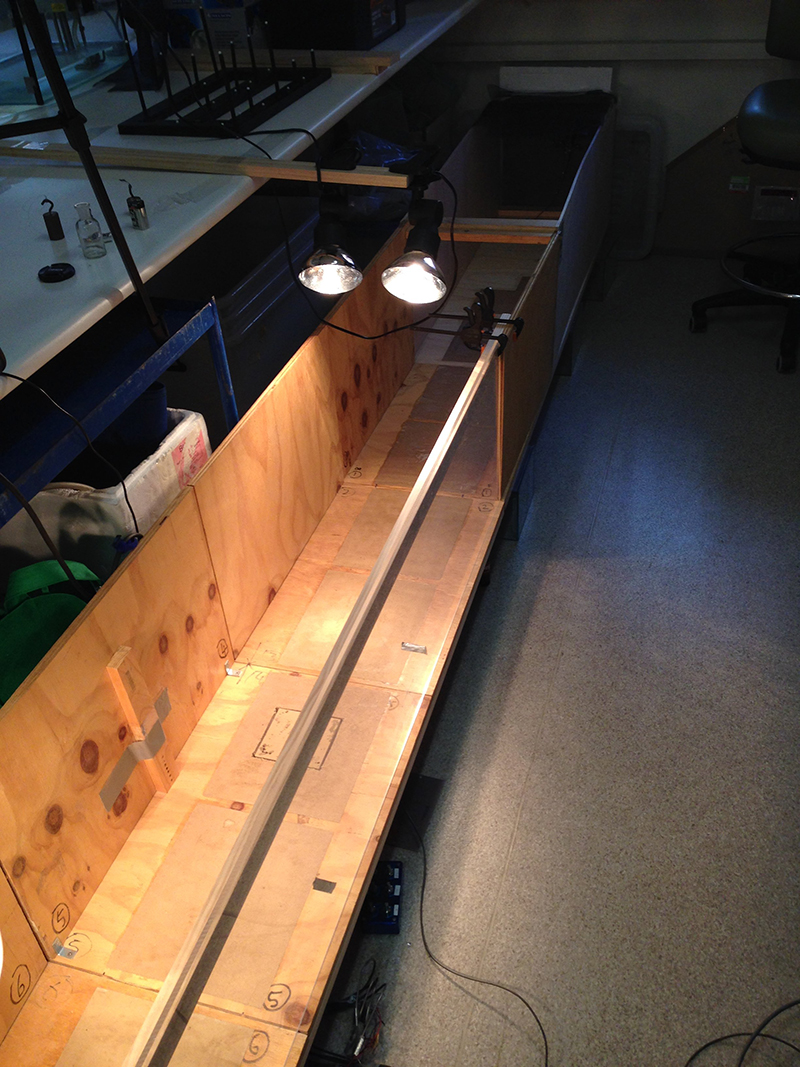
The researchers’ lizard ‘racetrack’, ready to capture the magic of bipedal movement. Credit: The University of Queensland

“We’re still teasing out why these species have evolved to run like this in the first place, but as we learn more, it’s clear that these lessons from nature may be able to be integrated into robotics,” Dr. Clemente said.

“It’s been suggested that this movement might have something to do with increasing vision in moments of urgency, by elevating the head at the same time and helping to navigate over obstacles.

“Indeed, bipedalism would be advantageous for robots in specific habitats, for example, on open grasslands where, in nature, many bipedal running agamids are found.

“如果谈判障碍indeed improved with bipedal locomotion, then we have shown how the tail and body can be moved to enable it sooner and for longer.

“Maybe adding a tail to robots can help them go ‘off-road’ sooner.”

The research is not only looking to the future, but to the past, by helping explain the evolution of bipedalism in dinosaurs and how they could have transitioned from walking on four legs to two legs.


Filed Under:Rapid prototyping,Robotics • robotic grippers • end effectors


Related ArticlesRead More >

PCB mills
Basics of printed circuit board milling machines
Rapid Product Solutions, Inc. enhances its rapid prototyping and production services
Protolabs Launches Production Capabilities for Metal 3D Printing
3 d打印机使维和行动和便宜Repair of Defense Systems Faster

DESIGN GUIDE LIBRARY

“motion

Enews Sign Up

Motion Control Classroom

Design World Digital Edition

cover

Browse the most current issueof Design World and back issues in an easy to use high quality format. Clip, share and download with the leading design engineering magazine today.

EDABoard the Forum for Electronics

Top global problem solving EE forum covering Microcontrollers, DSP, Networking, Analog and Digital Design, RF, Power Electronics, PCB Routing and much more

EDABoard: Forum for electronics

Sponsored Content

  • Case study: How a 3D-printed tool saved thousands of hours and dollars
  • WAGO’s smartDESIGNER Online Provides Seamless Progression for Projects
  • Stop over-designing: How to save time and money with a light-duty ring
  • Five Reasons: The 2065 Connector is a Reliable Alternative to Manual Soldering
  • Disaster recovery in industrial automation starts with source control
  • HELUAKBEL – Your Source for IE Cable Solutions

Design World Podcasts

February 27, 2022
What’s next for additive software
See More >
Engineering Exchange

The Engineering Exchange is a global educational networking community for engineers.

Connect, share, and learn today »

Design World
  • Advertising
  • About us
  • Contact
  • Manage your Design World Subscription
  • Subscribe
  • Design World Digital Network
  • Engineering White Papers
  • LEAP AWARDS

Copyright © 2022 WTWH Media LLC. All Rights Reserved. The material on this site may not be reproduced, distributed, transmitted, cached or otherwise used, except with the prior written permission of WTWH Media
Privacy Policy|Advertising|About Us

Search Design World

  • Home
  • Technologies
    • 3D CAD
    • Electronics • electrical
    • Fastening & Joining
    • Factory automation
    • Linear Motion
    • Motion Control
    • Test & Measurement
    • Sensors
    • 流体动力
  • Learn
    • Ebooks / Tech Tips
    • Engineering Week
    • Future of Design Engineering
    • MC² Motion Control Classrooms
    • Podcasts
    • Videos
    • Webinars
  • LEAP AWARDS
  • 领导
    • 2022 Voting
    • 2021 Winners
  • Design Guide Library
  • Resources
    • 3D Cad Models
      • PARTsolutions
      • TraceParts
    • Digital Issues
      • Design World
      • EE World
    • Women in Engineering
  • Supplier Listings
We use cookies to personalize content and ads, to provide social media features and to analyze our traffic. We also share information about your use of our site with our social media, advertising and analytics partners who may combine it with other information that you’ve provided to them or that they’ve collected from your use of their services. You consent to our cookies if you continue to use this website. OkNoRead more