

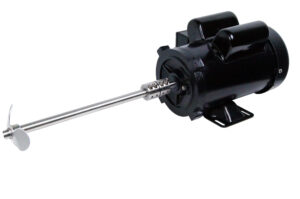
Clamp type stainless steel coupling from Ruland connecting a mixer motor to a propeller.
Mixers are one of the most common industrial applications. They feature a motor coupled to a paddle or propeller. While the connection is simple, mixers can be used in chemical, food, paint, adhesive and other industries complicating coupling selection.
The versatility and flexibility of mixers are what makes them challenging to specify a coupling for. The motor will be bearing supported while the paddle or propeller will not. This limits coupling selection to a rigid type as most standard servo couplings are not meant to be used without bearing support. Ruland manufactures set screw and clamp screw type rigid couplings to satisfy the needs of mixer applications.
Set screw rigid couplings are the most basic and common style. They are well suited for mixers in all industries due to their sleeve type construction which allows them to support the paddle or propeller without the need for a bearing. Set screw rigid couplings are machined from a solid piece of material and have two, four, or eight set screws. They derive all their holding power as the screw is tightened on the shaft. The amount of torque the coupling transmits is largely dependent on the material of the shaft which must be softer than the material of the screw to allow full impingement. The nature of the set screw is its biggest fault. When installed, it mars the shaft making removal difficult. In applications where frequent paddle or propeller change-outs are required, a set screw type may not be the best option.
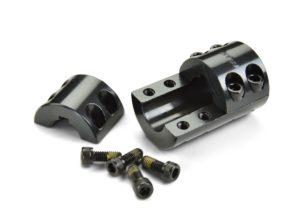
Example of a three-piece style rigid coupling from Ruland that removes the risk of a cross cut failure present in traditional clamp type rigid couplings.
Clamp style rigid couplings are an improvement over set screw style. They use compressive forces to wrap evenly around the shaft leading to a more secure connection. Standard variations include one- and two-piece types. Clamp rigid couplings have the advantages of not marring the shaft and infinite adjustability. Two-piece styles have all the benefits of one-piece while also allowing for in-place servicing, eliminating the need to remove adjacent components when installation or removal is required. Mixer designers benefit from quicker change-overs and less damage to propeller or paddle shafts. The primary drawback to using standard clamp type rigid couplings is the cross cut, which is a point of weakness and can fatigue over time, causing the coupling to fail. While this type of failure is rare, designers who want to use a clamp type coupling and prevent this failure can opt for a three-piece style or one with no crosscut.
Ruland manufactures straight bore rigid couplings with precision honed bores. Honing ensures collinearity and reduces the likelihood of the coupling introducing misalignment into the system. All clamp type hardware is supplied with proprietary Nypatch anti-vibration coating. Nypatch is a 360° nylon based coating applied around several threads of the screw. It provides for even seating of the screw, prevents galling, and allows for repeated screw installations. Nypatch saves end users considerable time in assembly as no additional screw treatment is necessary.
罗兰刚性联轴器品种是可用的of materials for mixers including 1215 lead-free steel, 303 and 316 stainless steel, and aluminum. Steel is the most common and available with a proprietary black oxide finish for smooth screw installation and a fine glossy finish. It is well suited for most industrial applications such as large volume paint mixers. Stainless steel types are used in food and high corrosion chemical mixing applications. The grade of stainless used is largely determined by the corrosiveness of the environment and regulatory requirements. Ruland uses hardware of like material to ensure consistent corrosion resistance. Aluminum is not commonly used, however, could be desirable if low inertia is required. Ruland manufactures rigid couplings in sizes from 1/8 (3 mm) to 2-in. (50 mm).
Ruland
www.ruland.com
Filed Under:Coupling Tips


Tell Us What You Think!