

PTC (NASDAQ: PTC) announced Creo 5.0, the latest release of its Creo 3D computer-aided design (CAD) software that enables users to go from concept to manufacturing in one design environment. Creo 5.0 introduces five new capabilities for product design and offers new productivity enhancements.
With Creo 5.0, concepts can be transformed into smart, connected products, bridging the physical and digital worlds with augmented reality (AR) capabilities in every seat. Creo 5.0 introduces capabilities in the areas of topology optimization, additive and subtractive manufacturing, computational fluid dynamics, and CAM.
“PTC is on the leading edge of some of the hottest technologies today with the Internet of Things (IoT) and augmented reality (AR), but it has not forgotten its roots in CAD, instead transforming this business by infusing its leading Creo software with new technologies and capabilities,” said John Mackrell, chairman, CIMdata. “Creo 5.0 is yet another example of PTC’s continued innovation and ability to meet customer needs.”
Topology optimization
The physical design of products is often limited by existing designs and practices. Creo Topology Optimization Extension automatically creates optimized designs based on a defined set of objectives and constraints, unfettered by existing designs and thought processes. This helps users save time and accelerate innovation by enabling creation of optimized and efficient parts.
Additive and subtractive manufacturing
Creo enables users to design, optimize, print check, and additively manufacture parts without the need for multiple pieces of software. By streamlining the process and reducing the need to recreate models, more time can be spent focused on what is really important, the design. Creo 5.0 introduces the Creo Additive Manufacturing Plus Extension for Materialise, which extends these capabilities to metal parts, allowing customers to print production-grade parts directly from Creo. Additionally, the extension allows users to connect to the Materialise online library of print drivers and profiles.
The Creo Mold Machining extension provides dedicated high-speed machining capabilities for molds, dies, electrodes, and prototype machining. Creo 5.0 supports 3-axis and 3+2 positioning machining.
Creo Flow Analysis
The Creo Flow Analysis extension is a computational fluid dynamics (CFD) solution, which allows designers, engineers, and analysts to simulate fluid flow issues directly within Creo. The seamless workflow between CAD and CFD allows users to integrate analysis early and often to understand product function and performance. The software is purpose-built specifically for the design engineer and is easy-to-use, directly integrated within Creo, highly accurate, and provides fast results.
Productivity improvements
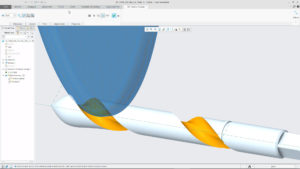
Creo 5.0 also includes key productivity improvements for the fast-changing world of product design, such as an improved user interface, geometry creation with sketch regions, and volume helical sweeps. Other enhancements include improvements to surfacing, sheet metal design, and the application of draft features involving rounds. Users can also now design in Creo while maintaining perspective display mode.
Creo协作扩展为一个utodesk Inventor enables organizations to consolidate onto a single CAD system, enabling them to reduce the cost and effort associated with maintaining multiple systems and integrations, and enabling better data reuse and resource sharing. Creo 5.0 will now support bi-directional exchange of both parts and assemblies with Autodesk Inventor.
“Product design is fundamentally changing, and Creo continues to evolve to meet the needs of our customers. With Creo, companies can go from the earliest phases of design to a smart, connected product,” said Brian Thompson, senior vice president, CAD Segment, PTC. “Improved functionality and new capabilities, like additive manufacturing, set Creo apart, and give companies a true competitive edge all the way from concept to manufacturing.”
PTC
www.ptc.com/en/products/cad/creo/whats-new
Filed Under:3D CAD World,3D printing • additive manufacturing • stereolithography


Tell Us What You Think!