Design World

  • Home
  • Technologies
    • 3D CAD
    • Electronics • electrical
    • Fastening & Joining
    • Factory automation
    • Linear Motion
    • Motion Control
    • Test & Measurement
    • Sensors
    • 流体动力
  • Learn
    • Ebooks / Tech Tips
    • Engineering Week
    • Future of Design Engineering
    • MC² Motion Control Classrooms
    • Podcasts
    • Videos
    • Webinars
  • LEAP AWARDS
  • 领导
    • 2022 Voting
    • 2021 Winners
  • Design Guide Library
  • Resources
    • Subscribe!
    • 3D Cad Models
      • PARTsolutions
      • TraceParts
    • Digital Issues
      • Design World
      • EE World
    • Women in Engineering
  • Supplier Listings

Metal Too ‘Gummy’ To Cut? Draw On It With Sharpie Or Glue Stick

ByPurdue University|July 18, 2018

Share

Your everyday permanent markers, glue sticks and packing tape may offer a surprisingly low-tech solution to a long-standing nuisance in the manufacturing industry: Making soft and ductile, or so-called “gummy” metals easier to cut.

What makes inks and adhesives effective isn’t their chemical content, but their stickiness to the surface of any gummy metal such as nickel, aluminum, stainless steels or copper, researchers at Purdue University and the University of West Florida find in a study recently published inPhysical Review Applied.

These adhesives help achieve a smoother, cleaner and faster cut than current machining processes, impacting applications ranging from the manufacturing of orthopedic implants and surgical instruments to aerospace components.

“A wide range of products rely on the machining of gummy metals. These could be something we use every day, such as the valve in a sink faucet, or something more critical like a compressor part in the jet engine of an airplane,” said James Mann, assistant professor of mechanical engineering at the University of West Florida and Purdue alumnus.

If a significant improvement can be made to the “machinability” of gummy metals or alloys – which is how well they cut, drill or grind – then there is potential to lower the cost of products, improve their performance or enable new and improved designs.

“Gummy metals characteristically deform in a very wiggly manner,” saidSrinivasan Chandrasekar, Purdue professor ofindustrial engineering. “This wiggly flow involves significant energy consumption, which means that these metals require more force to machine than even some hard metals. We needed to find a way to suppress this wiggly flow.”

For the rest of the storyclick here.
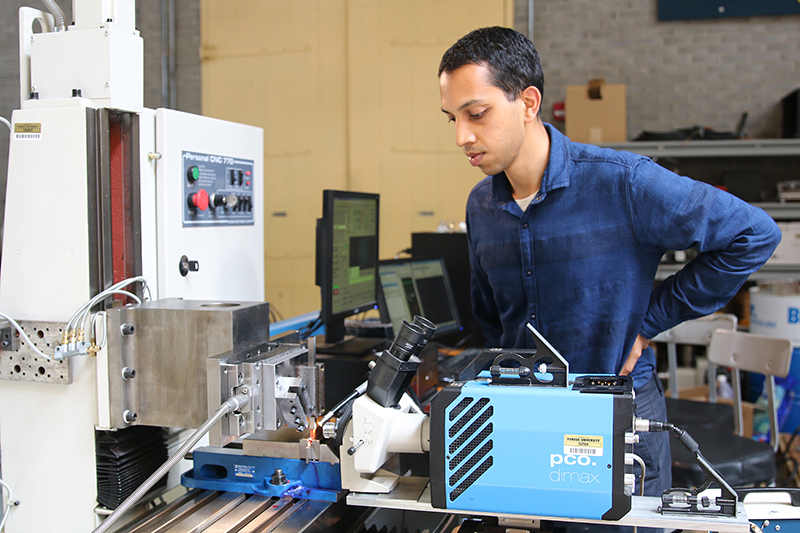
Purdue researcher Anirudh Udupa shows how marking a gummy metal’s surface with an ink or adhesive dramatically reduces the force required to cut it. (Purdue University image/Erin Easterling)


Filed Under:Materials • advanced


Related ArticlesRead More >

Self-lubricating and wear-resistant: igus bar stock for food, continuous operation and high media resistance
Minnesota Rubber and Plastics announces plans for new Innovation Center
The importance of resin selection
EXE014 - Image 1
Composite materials help place Italian race team in pole position

DESIGN GUIDE LIBRARY

“motion

Enews Sign Up

Motion Control Classroom

Design World Digital Edition

cover

Browse the most current issueof Design World and back issues in an easy to use high quality format. Clip, share and download with the leading design engineering magazine today.

EDABoard the Forum for Electronics

Top global problem solving EE forum covering Microcontrollers, DSP, Networking, Analog and Digital Design, RF, Power Electronics, PCB Routing and much more

EDABoard: Forum for electronics

Sponsored Content

  • Industrial disc pack couplings
  • Pushing performance: Adding functionality to terminal blocks
  • Get to Know Würth Industrial Division
  • Renishaw next-generation FORTiS™ enclosed linear encoders offer enhanced metrology and reliability for machine tools
  • Epoxy Certified for UL 1203 Standard
  • The Importance of Industrial Cable Resistance to Chemicals and Oils

设计世界播客

July 26, 2022
Tech Tuesdays: Sorbothane marks 40 years of shock and vibration innovation
See More >
Engineering Exchange

The Engineering Exchange is a global educational networking community for engineers.

Connect, share, and learn today »

Design World
  • Advertising
  • About us
  • Contact
  • Manage your Design World Subscription
  • Subscribe
  • Design World Digital Network
  • Engineering White Papers
  • LEAP AWARDS

Copyright © 2022 WTWH Media LLC. All Rights Reserved. The material on this site may not be reproduced, distributed, transmitted, cached or otherwise used, except with the prior written permission of WTWH Media
Privacy Policy|Advertising|About Us

Search Design World

  • Home
  • Technologies
    • 3D CAD
    • Electronics • electrical
    • Fastening & Joining
    • Factory automation
    • Linear Motion
    • Motion Control
    • Test & Measurement
    • Sensors
    • 流体动力
  • Learn
    • Ebooks / Tech Tips
    • Engineering Week
    • Future of Design Engineering
    • MC² Motion Control Classrooms
    • Podcasts
    • Videos
    • Webinars
  • LEAP AWARDS
  • 领导
    • 2022 Voting
    • 2021 Winners
  • Design Guide Library
  • Resources
    • Subscribe!
    • 3D Cad Models
      • PARTsolutions
      • TraceParts
    • Digital Issues
      • Design World
      • EE World
    • Women in Engineering
  • Supplier Listings
We use cookies to personalize content and ads, to provide social media features and to analyze our traffic. We also share information about your use of our site with our social media, advertising and analytics partners who may combine it with other information that you’ve provided to them or that they’ve collected from your use of their services. You consent to our cookies if you continue to use this website. OkNoRead more