

In the late 1980s, Stratasys founder Scott Crump printed a frog on a FDM printer in his kitchen.
Today, students at the Anthropological Institute of the University of Zurich use Stratasys 3D printers to study the skull fragments of Neanderthal infants. To cut down on handling fragile fossils, they students scan them and reproduce 3D printed models that can stand up to frequent handling and that help them reproduce the infant’s skull.
Three-dimensional printing—particularly when it comes to materials used for the job–has seen its own evolution since the time of Crump’s printed frog.
Users today can choose from a variety of printing materials to suit their unique needs. Different types of PolyJet photopolymers can be of biomedical grade, suitable for use in medical devices; they can simulate standard ABS plastics; or retain dimensions under very high heat by simulating the thermal performance of engineered plastics. Or, they can contain rubber-like qualities. They can even simulate polypropylene to withstand the stress of hinges, closures, and snap-fit parts.
Then there are the digital materials. These are the result of combining two or three PolyJet photopolymers in specific concentrations and microstructures to create a composite material with hybrid characteristics.
Many Materials at Once
The 3D printing came for materials when Stratasys introduced its multi-materials printers–J750, Objet500 Object 350, and Connex3–that can print with different materials at once and in multiple colors.
Those in the industry had accepted that different materials had to be printed in specific ways with regard to factors like pressure and temperature. So printing something complex usually involved printing all the individual pieces separately and then having someone assemble them by hand.
But these multimaterial printers can print complicated objects that combine materials to give various parts of the object different properties. The J750, for example, produces whole–product prototypes in full color with multiple materials, textures and gradients in as little as a few hours.
That opens up new possibilities with the power to create objects that have previously been difficult or even impossible to print.
The capability to print materials with different properties at the same time has already helped designers and product manufacturers in many industries, from education to consumer electronics to medical, printing everything from smartphone cases to LED lenses. With much more to come. Perhaps objects we haven’t even dreamed of yet.
Meanwhile, let’s take a look at how these materials are already being deployed within a few industries.
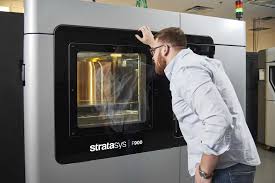
WIth 3D printing, an object is built up inside the printer, layer by layer.
Medical
Instead of waiting to train on new procedures, physicians at Jacobs Institute use 3D printed models of patients with stroke, clots, aneurysms and other pathologies to develop surgical skills in a no-risk environment. The models are customized to present a range of anatomies so physician participants are exposed to the limits of what they will see when treating living patients.
“We use 3D printing technology and materials to create a lifelike vascular environment that isn’t achievable any other way,” said Mike Springer, director of operations and entrepreneurship at the Jacobs Institute.
The J750 printer, with its various materials and colors, provides doctors and researchers the tools to create patient–and condition–specific anatomy models for education and research.
The 3D-printed models can mimic a range of tissues more realistically than processed cadavers, which no longer retain the feeling of live tissue. The models can incorporate access points, sensors and blood-flow simulation, enabling highly dynamic and interactive training. Complications can be designed into the model to ensure the first time a trainee faces a complex challenge is not with a patient on the table.
Where Rubber Meets the Road
Meanwhile, the prototyping lab at Trek Bicycle in Waterloo, Wis., was among the first to adopt the Objet500 Connex3 multi-material 3D printer. The material mix helps them create prototypes that look and feel like production parts. And they have more material options at their fingertips than ever before. The system builds color parts with clear, tinted and flexible components all in one job.
Specifically, engineers at Trek embraced the capability to integrate soft rubber-like components into models built from their favorite prototyping material, durable Digital ABS. This is crucial because so many bike parts and accessories contain rigid and soft components. Before Connex3, the lab would have had to build those devices in separate jobs, swapping out 3D printing materials in between, and then bond the components. Or, to print in one job, downgrade the rigid portions to a less durable, non-composite material, said engineering tech Guadalupe Ollarzabal.
Filed Under:3D CAD World,3D printing • additive manufacturing • stereolithography


Tell Us What You Think!