

3 d打印的栖息地是一个挑战competition to create sustainable shelters suitable for the Moon, Mars or beyond using resources available on-site in these locations. The multi-level 3D-Printed Habitat Challenge puts teams to the test in several areas of 3D-printing, including modeling software, material development and construction. In addition to aiding human space exploration, technologies sought from this competition could also lead to lower-cost housing solutions on Earth and other benefits.
The challenge, which began in 2015, is structured in phases, each with multiple levels. Phases to date include:
- Phase 1, (completed) the Design Competition, required teams to submit architectural renderings and was completed in 2015. ($50,000 prize purse)
- Phase 2, (completed) the Structural Member Competition, focused on material technologies, requiring teams to create structural components. It was completed in 2017. ($1.1 million prize purse)
- Phase 3(current), the On-Site Habitat Competition, comprises five levels that test teams’ ability to advance technology to autonomously construct a habitat and will culminate in a head-to-head habitat print in April 2019. ($2 million prize purse)
The multi-level competition structure enables more teams to be involved, and for teams to participate based on their strengths. Teams may enter or exit the competition at any phase or level, provided that they meet thechallenge requirements.
The challenge is managed through a partnership with NASA’s Centennial Challenges program andBradley University. Bradley has partnered with sponsorsCaterpillar,Bechtel,Brick & Mortar Venturesand theU.S. Army Corps of Engineersto administer the competition. NASA’sCentennial Challengesprogram is part of the agency’sSpace Technology Mission Directorate, and is managed at NASA’s Marshall Space Flight Center in Huntsville, Alabama.
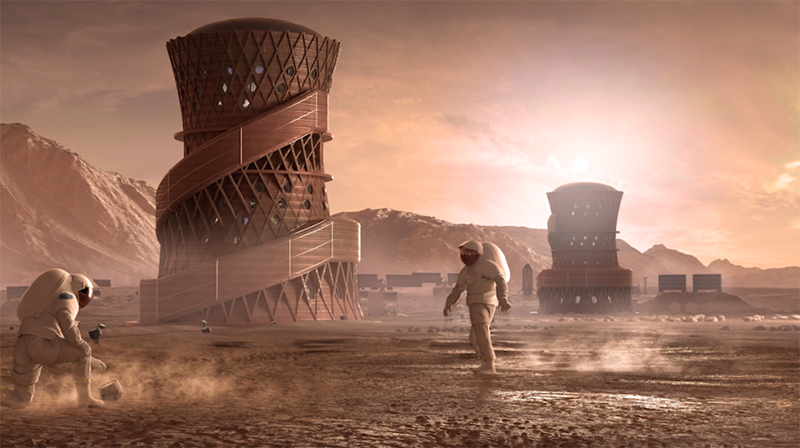
Team SEArch+/Apis Cor won first place in the Phase 3: Level 4 software modeling stage of NASA’s 3D-Printed Habitat Challenge. The unique shape of their habitat allows for continuous reinforcement of the structure. Light enters through trough-shaped ports on the sides and top. Credits: Team SEArch+/Apis Cor
Top Three Teams Share $100,000 Prize in Complete Virtual Construction Level of 3D-Printed Habitat Challenge
March 27, 2019
Teams competing in NASA’s 3D-Printed Habitat Challenge completed the latest level of the competition – complete virtual construction – and the top three were awarded a share of the $100,000 prize purse. This stage of the challenge required teams to create a full-scale habitat design, using modeling software. This level built upon anearlier stagethat also required virtual modeling.
The virtual design from team Mars Incubator won third place in the Phase 3: Level 4 software modeling stage of NASA’s 3D-Printed Habitat Challenge. The team is a collection of engineers and artists.
Watch their virtual video model here.
Eleven team entries were scored and awarded points based on architectural layout, programming, efficient use of interior space, and the 3D-printing scalability and constructability of the habitat. Teams also prepared short videos providing insight into their designs as well as miniature 3D-printed models that came apart to showcase the interior design. Points were also awarded for aesthetic representation and realism. After evaluation by a panel of judges, NASA and challenge partner Bradley University of Peoria, Illinois, awarded the following teams:
- SEArch+/Apis Cor – New York – $33,954.11
- Zopherus – Rogers, Arkansas – $33,422.01
- Mars Incubator – New Haven, Connecticut – $32,623.88
The 3D-Printed Habitat Challenge will culminate with a head-to-head subscale structure print May 1-4, 2019, and the awarding of an $800,000 prize purse. Media and the public will be invited to attend the event in Peoria, Illinois.
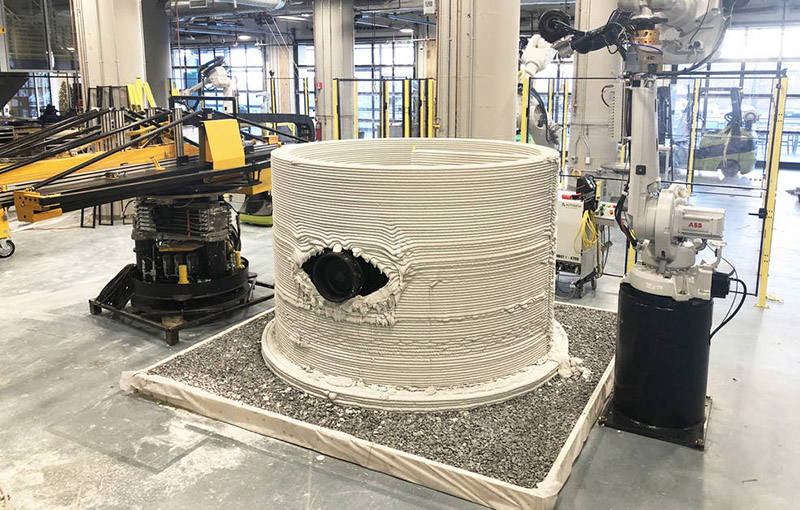
A 3D-printed structure from team SEArch+/Apis Cor is being prepared for hydrostatic leak testing. The team won first place in Phase 3: Level 3 of the 3D-Printed Habitat Challenge. The test is performed by filling the structure with water to a specified depth and measuring the leakage rate by the rate of the drop in the water level. Credits: SEArch+/Apis Cor
四大团队分享300000美元的奖金在密封测试tage of 3D-Printed Habitat Challenge
Feb. 1, 2019
四个成功的团队将分享300000美元的奖金ful completion of the seal test stage of the 3D-Printed Habitat Challenge, a competition to create sustainable shelters suitable for the Moon, Mars or beyond using resources available on site in these locations. For this level of the competition, teams submitted 3D-printed samples that were tested for their ability to hold a seal, for strength and for durability in temperature extremes.
Six teams submitted entries to the competition, and after evaluation by a team of judges, NASA and challenge partner Bradley University of Peoria, Illinois, awarded the following teams:
- SEArch+/Apis Cor – New York – $104,987.46
- AI. SpaceFactory – New York – $88,353.30
- Pennsylvania State University – State College – $83,755.92
- Colorado School of Mines and ICON- Golden, Colorado – $22,903.32
The multi-level 3D-Printed Habitat Challenge puts teams to the test in several areas of 3D printing, including modeling software, material development and construction. There are two software design levels and three construction levels. The seal test level is the final construction level teams must pass to be eligible to compete in the final level, a head-to-head printing of a structure that will take place in April 2019.
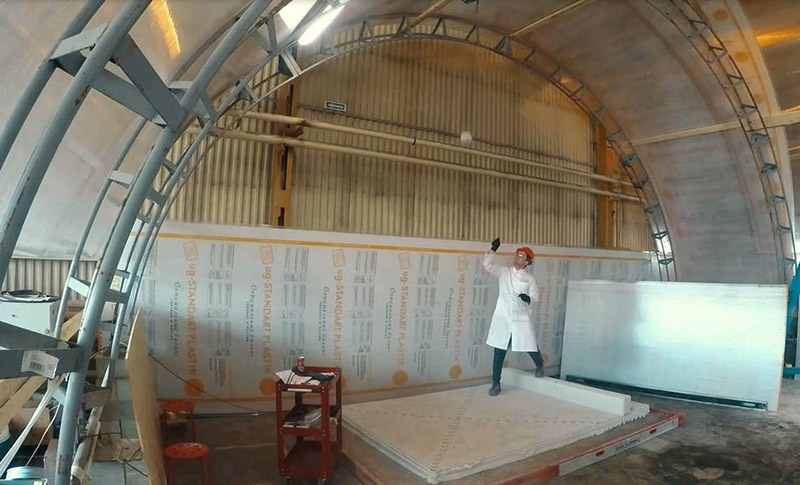
Team SEArch+/Apis Cor of New York won first place in Phase 3: Level 2 of NASA’s 3D-Printed Habitat Challenge. Team SEArch+/Apis Cor of New York won first place in Phase 3: Level 2 of NASA’s 3D-Printed Habitat Challenge. For this level, they printed a foundation and subjected it to various tests, including dropping a shotput on it to simulate a meteor strike. Watch the full video of their entry and testing. Credits: SEArch+/Apis Cor
Teams Win a Share of $120,000 in Foundation Construction Stage of NASA’s 3D-Printed Habitat Competition
Aug. 22, 2018
Three teams will share a $120,000 prize offered in the second of five levels of phase 3 ofNASA’s 3D-Printed Habitat Centennial Challengecompetition. The goal of the public challenge is to create sustainable shelters suitable for the Moon, Mars or beyond using resources available on site. The five levels put teams to the test in all areas of 3D-printing, from usingsoftware to design habitatsto developing materials that can be used to print a physical structure.
After evaluating the Level 2 entries, the challenge partner Bradley University in Peoria, Illinois and NASA selected the following teams for award:
- SEArch+/Apis Cor of New York – $55,154.77
- Pennsylvania State University, State College, Pennsylvania – $32,914.75
- FormForge|Austin Industries|WPM of Austin, Texas – $31,930.48
For this level of the competition, teams had to additively construct a foundation slab without human intervention. The slabs were evaluated and scored based on multiple criteria, including strength, durability and material composition. To test their strength, a standard Olympic shot put was dropped on each slab three times to simulate a meteor strike. For durability, each slab was subjected to freeze/thaw tests, enduring temperature extremes. The teams earned prize money based on scores assigned by a panel of subject matter experts from NASA, academia and industry.
“This level prepares the teams for more difficult levels to come, and they had to do it autonomously, which adds an extra level of difficulty that will be necessary for space exploration,” said Monsi Roman, program manager for NASA’s Centennial Challenges. “Each of the skills tested in these levels will come into play for the final competition next spring.”
Filed Under:Rapid prototyping


