

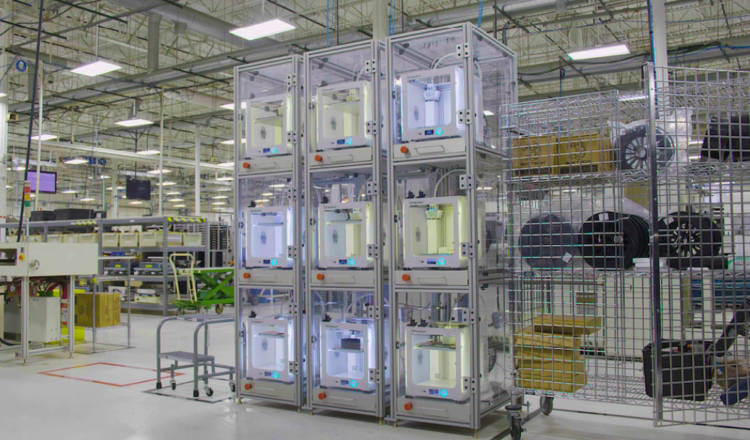
Jabil’s Auburn Hills, Mich.-based facility uses Ultimaker 3D printing to make tooling and fixtures in 80% less time and at 30% lower cost. (Credit: Tim DeRosett, Jabil)
A steady pace of innovations underscoreJabil‘s mission to be the most technologically advanced manufacturing solutions provider in the world. To that end, the company continually weaves a digital thread across its 100 facilities in 29 countries to connect people, processes and plants with suppliers, partners and customers in new and powerful ways.
At Jabil’s Auburn Hills, Mich.-based facility, for example, a constant focus on continuous improvement has led to the exploration of new technologies for addressing high-mix, low-to-medium volume manufacturing requirements.
“We must ensure Auburn Hills delivers excellence in execution by offering the best solutions for our customers,” explains Karin Alcorn, Operations Manager for Auburn Hills. “At our facility, the team works hard to empower innovation for a variety of healthcare and industrial customers.”
In addition to healthcare, Auburn Hills supports the specialized manufacturing requirements of transportation, IoT and analytical instrumentation customers. An overarching goal for all customers is the need to reduce time, cost and risk in bringing products to market.
“Typically, products are made in very high volumes to bring down costs, which means you would have the same product over a lifecycle measured in millions of parts,” explains Rush LaSelle, Senior Director of Business Development, Jabil Additive Manufacturing. “New technologies, such as 3D printing, completely change the economic value equation because now we can produce a lot size of one as affordably as much larger volumes.”
Rethinking Traditional Manufacturing Methods
To better address smaller batch sizes and reduced product lifecycles, the Auburn Hills team was early to evaluate and validate the use of additive manufacturing. Historically, machine shops played a significant role as they were the predominant source for fixtures, jigs and other tooling needed for production. Timeframes and costs to produce these vital manufacturing aids could vary wildly depending on design complexity and quantity.
Jabil Keynoting Robotics Summit & Showcase
John Dulchinos, Jabil’s VP 3D Printing and Digital Manufacturing, is delivering a keynote at theRobotics Summit and Showcase(May 23-24 in Boston).

Dulchinos
Dulchino’s keynote “Producing Commercial Class Robotics Systems: Challenges and Advanced Manufacturing Solutions” will describe some major go-to-market challenges for robotics companies and how advanced manufacturing solutions help overcome them.
Register for theRobotics Summitby April 20 and save 20% with early bird registration. Learn from and network with the best minds in robotics and unlock the keys to developing next-gen commercial robotics systems.
Agenda|Keynotes|Speakers|Sponsors|Register
“It could take up to three weeks for a machine shop to make a simple tool,” notes John Wahl VI, Tooling and Manufacturing Engineer for Jabil Auburn Hills. “For something more complicated with moving parts, it could take up to two months.”
减少时间限制是最appe之一aling aspects of additive manufacturing since one of its key tenets is the ability to tailor products without requiring lots of engineering cycles in the manufacturing process.
“3 d打印技术减少了约束ssociated with traditional manufacturing technologies,” adds LaSelle. “Product designers are empowered to focus on outcomes and part performance as opposed to investing excessive time and expense designing for the production process itself.”
Jabil’s design engineers often dealt with different cost models as the prices to produce one-offs were significantly higher than producing tooling in larger volumes. Other issues arose when customers expressed concerns over sharing new product designs with anyone outside Jabil. Conveying designs without much detail about the end-product often led to extra design cycles.
Overall, the traditional tooling process often impeded Jabil’s ability to streamline New Product Introductions (NPI) since multiple iterations were needed to finalize fixtures. “We were challenged to get what we needed, when we needed it,” says Alcorn. “We decided to take control of our destiny and develop our own tooling capabilities to better support our customers.”
How 3D Printing Speeds Time to Market
Fueled by the promise of bringing products to market faster, the Auburn Hills team explored 3D printing for producing tooling, fixtures and jigs in-house. The team received training from Jabil Additive’s specialists on 3D printing hardware, software and Design for Additive Manufacturing (DfAM) principles.
“We realized benefits almost immediately,” Wahl says. “Within three hours of setting up the firstUltimaker 3D printer, we had a job to print spare parts. The alternative was to stop manufacturing until the part could be produced, but we made them that day using 3D printing.”
Following that success, Auburn Hills rapidly ramped 3D printing for a variety of use cases. “With 3D printing, there is no minimum quantity, and one-offs are no longer a cost constraint,” adds Wahl. “By locating machines within Auburn Hills, we could dictate the priority, timeliness and printing method ourselves.”
One of Auburn Hills’ early additive manufacturing successes involved a medical technologies customer seeking to streamline production of an innovative mobile imaging system.
捷普电子工程师在f看到改进的余地ixture aesthetics and product functionality as well as an opportunity to simplify and speed production while making the line move easier for the operator.
Engineering the Future of Robotics
Register for theRobotics Summit and Showcase(May 23-24, Boston) by April 20 and save 20% with early bird registration. Learn from and network with the best minds in robotics and unlock the keys to developing next-gen commercial robotics systems.
Agenda|Keynotes|Speakers|Sponsors|Register
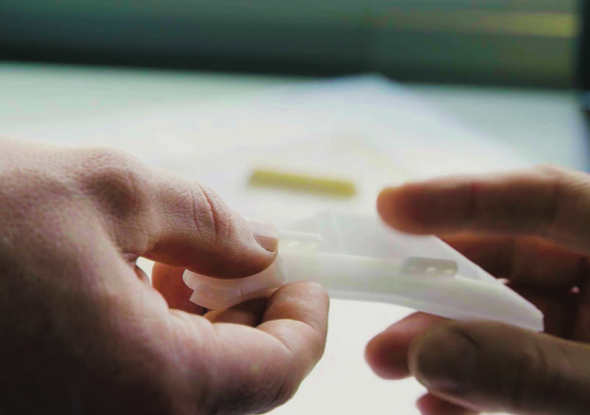
After brainstorming and whiteboarding the process, the team modeled and produced 3D-printed fixtures and tools overnight, followed by rigorous testing to qualify and validate performance. The ability to quickly turn around revision changes had the largest impact on the project’s success.
“We verified a design change and then printed a full working unit in hours,” says Wahl. “Previously, a typical timeframe to go from problem discovery to final solution could take months. With 3D printing, we completed that entire process in weeks.”
Another early success involved high-level assembly for a new product, which required the development of drawings, models and assembly concepts for tooling, fixtures and jigs.
By developing those manufacturing aids in-house, Auburn Hills slashed design time in half while substantially reducing lead time to produce the parts. Previously, it would have taken up to two months to produce the part using an outside machine shop. With 3D printing, however, lead time was reduced to four days.
Moreover, the team was able to develop the parts for a fraction of the cost of purchasing the same from a machine shop.
In fact, Auburn Hills can now produce tooling based on customer product CAD models prior to receiving the actual parts, which gives them a jump on production. As 3D printing has become an integral part of the production process, the list of real-world successes continues to grow.
“3D printing has saved the day on numerous accounts,” Wahl says. “There were several times when something broke or malfunctioned on the production line, but we could quickly replicate the broken part or implement another tool or fixture using 3D printing. Before people even knew the line was down, we got them back up and running again.”
‘If You Think It, We Can Print It’
Thanks to a strong partnership with Jabil’s additive manufacturing experts, Auburn Hills’ product designers and engineers have mastered different 3D printing techniques.
“The Auburn Hills team has been exceptional in not only understanding how to apply the technology but in championing the benefits with customers,” notes LaSelle. “They understand the tangible impact to our factories and customers’ businesses.”
Auburn Hills is achieving upward of 30% price reductions in the cost oftooling and an 80% decrease in the time to produce final tools andfixtures.
Early customer feedback has been overwhelmingly positive. “They love everything about it,” says Alcorn. “The fact that it’s flexible, and there’s a faster turnaround time, enables us to deliver better results because we can react immediately to manufacturing opportunities.”
Customers appreciate the freedom to iterate quickly and frequently so tools and the manufacturing machines they support can be optimized to produce higher yields. Equally impressive is the product design freedom.
“If you can think it, we can print it,” says Wahl. “It’s amazing to take someone’s idea and 3D print it overnight. We’ve been surprised with all that can be accomplished with greater freedom on the creative side.”
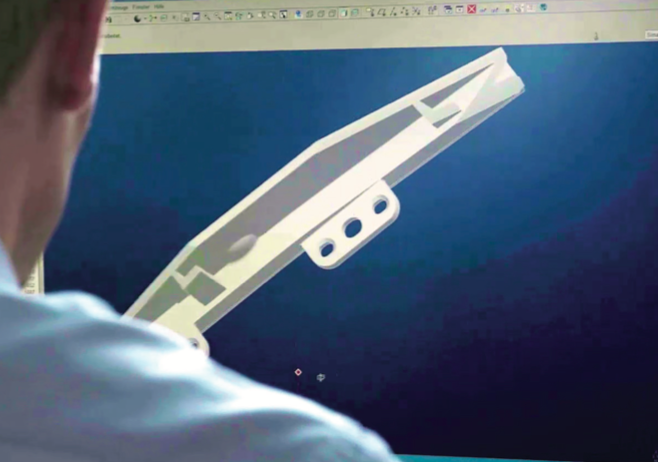
This ability to take any design and produce a 3D-printed solution impacts both ends of the product lifecycle, including Maintenance, Repair and Obsolescence (MRO). “3D printing is a critical pillar in the overarching digital manufacturing umbrella as we’ll start to see spare parts made in the field from a digital file,” asserts LaSelle. “This alleviates a lot of pain on the back-end of a product’s lifecycle.”
As an early adopter, Auburn Hills is well positioned to expand its use of additive manufacturing. The team is evaluating the opportunity to expand its current library of materials and the addition of different types of 3D printers.
“We’re continuing to advance our use of 3D printing technology, working with our business and operations teams to address emerging customer requirements,” says Alcorn. “I’m excited to see what’s next.”
For Jabil, the rapid ramp of 3D printing at Auburn Hills is a testament to the viability of the technology and Jabil’s proven processes. As expected, other facilities are beginning to use 3D printing globally.
“This is a case where the network effect of the digital thread is connecting our design community around the world,” notes LaSelle.
“The idea of design democratization is emerging from Jabil’s strong design competency for additive manufacturing, which will result in a global repository of great engineering, designs and parts.”
Filed Under:3D printing • additive manufacturing • stereolithography,The Robot Report


Tell Us What You Think!