

LAN cable certifiers are the go-to method of testing twisted pair cabling. But why do installers need to certify cabling? And what is the difference between a certifier and other types of LAN testers? In this post, Dan Barrera, Global Product Manager from IDEAL Networks offers some insight.
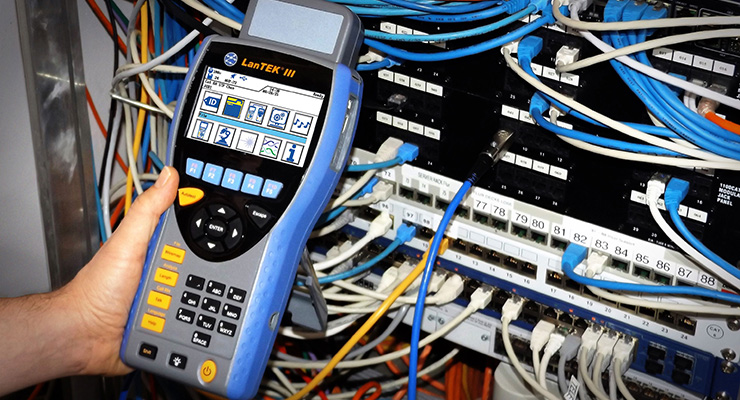 “Put simply, the first two elements of a LAN cabling system are the cable and the connectors. The third is the installation of those elements in the field, and this is what LAN cable certifiers test,” explains Dan. “Quality connectors and cable will provide their advertised performance when properly installed in laboratory environments, but installation in the field is very different to installation in a laboratory.”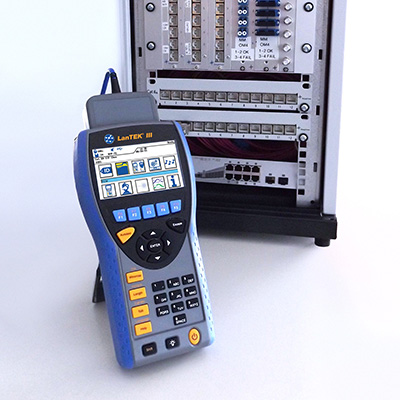
In the field, the cable can be stretched, kinked, crushed, installed in hot areas, exposed to water, and terminated with poor workmanship. Therefore, to ensure that the individual quality components form a completed, quality cabling system, installers need to test the performance of that cabling in the field.
However, there are also cabling standards to consider. The two main standardization bodies that define LAN cabling specifications are the ISO/IEC with the 11801 series standards and ANSI/TIA with the 568 series of standards. These standards define performance requirements for components, cable and cabling.
The component and cable standards are used by manufacturers for design and testing, but the cabling standard is a consideration for field engineers testing installed cabling. This standard defines the required performance of completed links and channels when connectors and cable are installed in the field. This field testing is critical because the link and channel performance is what determines whether networking equipment will operate properly and provide the advertised bandwidth.
“I’m often asked why a certifier is needed rather than a LAN cable qualifier,” says Barrera. “This is down to standards which play a key role in certification — the test and accuracy requirements for cable certifiers are developed in conjunction with the performance requirements for cabling.”
Conversely, cable qualification has no defined tests, performance or accuracy specifications in the standards organizations. Qualification is left up to the manufacturer of the LAN qualifier to decide what to test, how accurate the instrument is and how to report the results.
“The problem with this is that the results from one brand of qualifier cannot be compared to another,” he continued. “Plus, without a definition for pass/fail limits, what does it mean when a qualifier “fails” a cable?”
For these reasons, no major cable or connector manufacturer will accept test results from a qualifier for their cable certification or warranty programs.
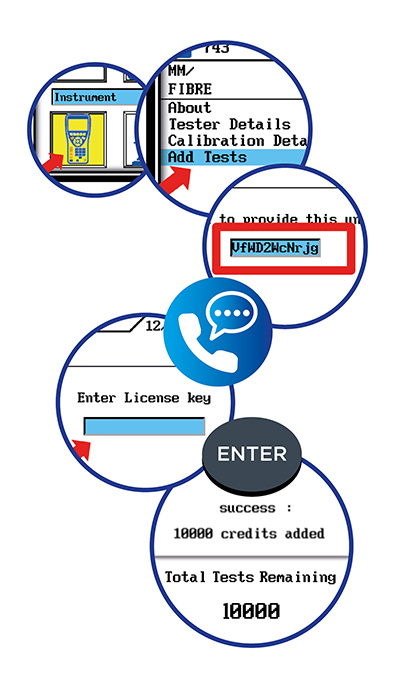
IDEAL Networks’s Pay As You Test Model
“The difficulty for installers is that it is not always easy to tell whether a tester is a qualifier or a certifier,” said Barrera. “However, as a certifier must meet certain criteria it can actually be easily identified.”
For example, a tester is considered a certifier if it meets ISO/IEC 61935 and TIA 1152-A accuracy requirements and has ETL Level III/IIIe verified accuracy. A certifier can also be recognized by looking at what it is capable of measuring. If it measures NEXT, PSNEXT, Return Loss, Insertion Loss and ACR-F and specifies a test frequency range of at least 500 MHz, then it is a certifier.
Due to the significant upfront investment required for certifiers, IDEAL Networks offers a “Pay As You Test” option. This allows businesses to transform a certifier fleet from a capital investment into an operational expense. A “Pay As You Test” plan can allow test credits to be purchased in batches and topped up when needed. There are two options; a “free on loan” certifier agreement with no upfront costs, or the ability to purchase the certifier with an additional up-front payment.
“Certifiers are the best tool to guarantee installed cabling meets the stringent performance requirements defined by the ISO/IEC and ANSI/TIA standards bodies,” Barrera concluded. “In short, they find faulty components, sources of installation mistakes, and help ensure that the materials are genuine products and not poor quality.”
IDEAL Networks
www.idealnetworks.net
www.test4less.net/us
Filed Under: Uncategorized
Tell Us What You Think!