Design World

  • Home
  • Technologies
    • 3D CAD
    • Electronics • electrical
    • Fastening & Joining
    • Factory automation
    • Linear Motion
    • Motion Control
    • Test & Measurement
    • Sensors
    • 流体动力
  • Learn
    • Ebooks / Tech Tips
    • Engineering Week
    • Future of Design Engineering
    • MC² Motion Control Classrooms
    • Podcasts
    • Videos
    • Webinars
  • LEAP AWARDS
  • Leadership
    • 2022 Voting
    • 2021 Winners
  • Design Guide Library
  • Resources
    • 3D Cad Models
      • PARTsolutions
      • TraceParts
    • Digital Issues
      • Design World
      • EE World
    • Women in Engineering
  • Supplier Listings

What is sinusoidal commutation for DC motors?

ByDanielle Collins|November 6, 2016

Share

Although their back EMF waveform of a brushless DC (BLDC) motor is theoretically trapezoidal, in reality, inductance in the motor smooths the back EMF into a more sinusoidal shape. This is why BLDC motors can use either trapezoidalorsinusoidal commutation methods. While trapezoidal commutation is the simpler of the two methods, it produces significant torque ripple at each commutation step (every 60 degrees). Sinusoidal commutation eliminates the torque ripple inherent to trapezoidal commutation and provides smooth motion and precise motor control.
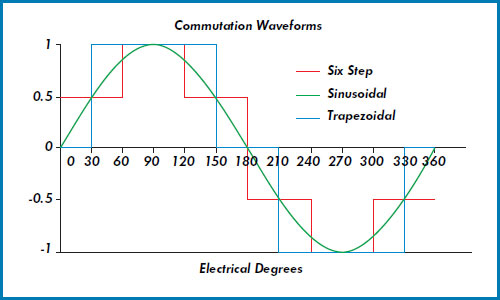
Sinusoidal Commutation

Sinusoidal commutation eliminates the torque ripple that occurs with trapezoidal or six step (also called “modified trapezoidal”) methods.
Image credit: Aerotech Inc.

The basic premise behind sinusoidal commutation is to provide each of the motor windings with currents that vary sinusoidally as the motor turns. The currents are phase shifted by 120 degrees, to match the orientation of the stator windings. The current space vector has constant magnitude and is always orthogonal to the rotor. (Recall that maximum torque is produced when the stator and rotor magnetic fields are orthogonal, or at 90 degrees, to each other.) A key to achieving sinusoidal commutation is the ability to accurately determine the rotor position. Since Hall devices provide only a rough measurement of rotor position, an encoder is typically used to provide rotor position information.

Based on the rotor position, two sinusoidal waveforms are created, 120 degrees phase shifted from each other. Multiplying these signals by the torque command produces amplitudes that are proportional to the desired torque. These commands are fed to the controller, which regulates the current in the motor windings. According toKirchhoff’s current law, the sum of the three currents must be equal to zero, so the current in the third motor winding is the negative sum of the first two (to maintain a zero sum of the three), and therefore, cannot be controlled directly.
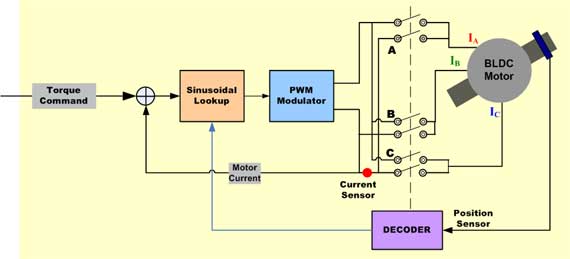
Sinusoidal Commutation

Block diagram of sinusoidal commutation for a BLDC motor.
Image credit: Renesas Electronics Corporation


To see how this works, let’s look at the torque equation for a three-phase motor:

T = Kt * [IA* Sin(θ) + IB* Sin(θ +120) + IC* Sin(θ +240)]

Where:

T = torque

Kt = torque constant

IA, IB, IC= phase currents

θ = electrical angle of shaft

Because the phase currents are sinusoidal:

IA= M * Sin(θ)

IB= M * Sin(θ+120)

IC= M * Sin(θ+240)

Where M = motor current command with respect to the angle θ

Substituting, we get:

T = Kt * M * [(sin2(θ) + sin2(θ+120) + sin2(θ+240)]

Solving the trigonometric functions* gives us:

T = Kt * M * 1.5 * [sin2(θ) + cos2(θ)]

Sincesin2(θ) + cos2(θ) = 1, the equation simplifies to:

T = 1.5 * Kt * M

This shows that torque is independent of the shaft angle, thus eliminating torque ripple.


*The trigonometry to solve this equation gets quite complicated, but if you’re interested in the full derivation, check out Appendix A of thisApplication Notefrom Galil Motion Control.


The downside of sinusoidal commutation is that it becomes inefficient at high speeds. The faster the motor turns, the higher the frequency of the sinusoidal signals, and controllers have difficulty tracking these high-frequency signals. Higher motor speeds also cause back-EMF to increase in both amplitude and frequency, making it more difficult for the motor to overcome. Both of theses conditions result in disturbances to the current control loop and cause phase lag and errors in the currents. The result is that the current space vector moves away from the ideal (orthogonal) position relative to the rotor, and less torque is produced by a given amount of current.

Motion Control Tips


Filed Under:Motion Control Tips,Motion control • motor controls
Tagged With:galilmotioncontrol

About The Author

Danielle Collins

Related ArticlesRead More >

Motion & Control Enterprises purchases RSA and Global Controls, fourth acquisition this year
49503-ACS Motion-CMxa
ACS Motion Control releases SPiiPlusCMxa EtherCAT motion controller
SDP-SI-040
SDP/SI launches brushless DC motors and motion control products series
PACMotion-servos
High-performance integrated motion control line from Emerson

DESIGN GUIDE LIBRARY

“motion

Enews Sign Up

运动控制班ssroom

Design World Digital Edition

cover

Browse the most current issueof Design World and back issues in an easy to use high quality format. Clip, share and download with the leading design engineering magazine today.

EDABoard the Forum for Electronics

Top global problem solving EE forum covering Microcontrollers, DSP, Networking, Analog and Digital Design, RF, Power Electronics, PCB Routing and much more

EDABoard:电子论坛

Sponsored Content

  • WAGO’s custom designed interface wiring system making industrial applications easier
  • Global supply needs drive increased manufacturing footprint development
  • 10 Reasons to Specify Valve Manifolds
  • Case study: How a 3D-printed tool saved thousands of hours and dollars
  • WAGO’s smartDESIGNER Online Provides Seamless Progression for Projects
  • Stop over-designing: How to save time and money with a light-duty ring

Design World Podcasts

April 11, 2022
Going small with 3D printing
See More >
Engineering Exchange

The Engineering Exchange is a global educational networking community for engineers.

Connect, share, and learn today »

Design World
  • Advertising
  • About us
  • Contact
  • Manage your Design World Subscription
  • Subscribe
  • Design World Digital Network
  • Engineering White Papers
  • LEAP AWARDS

Copyright © 2022 WTWH Media LLC. All Rights Reserved. The material on this site may not be reproduced, distributed, transmitted, cached or otherwise used, except with the prior written permission of WTWH Media
Privacy Policy|Advertising|About Us

Search Design World

  • Home
  • Technologies
    • 3D CAD
    • Electronics • electrical
    • Fastening & Joining
    • Factory automation
    • Linear Motion
    • Motion Control
    • Test & Measurement
    • Sensors
    • 流体动力
  • Learn
    • Ebooks / Tech Tips
    • Engineering Week
    • Future of Design Engineering
    • MC² Motion Control Classrooms
    • Podcasts
    • Videos
    • Webinars
  • LEAP AWARDS
  • Leadership
    • 2022 Voting
    • 2021 Winners
  • Design Guide Library
  • Resources
    • 3D Cad Models
      • PARTsolutions
      • TraceParts
    • Digital Issues
      • Design World
      • EE World
    • Women in Engineering
  • Supplier Listings
We use cookies to personalize content and ads, to provide social media features and to analyze our traffic. We also share information about your use of our site with our social media, advertising and analytics partners who may combine it with other information that you’ve provided to them or that they’ve collected from your use of their services. You consent to our cookies if you continue to use this website. OkNoRead more