

The location ofmechanical couplings — connecting rotating shafts powered by electric motors and fairly close to the loads being moved or manipulated — makes it an ideal place to optimize the performance of machine axes. No wonder that our 2020 Design World Trends survey of industry experts indicates an uptick in innovation related to optimizing the torque and angular velocity through couplings and (with flexible variations) compensation for misalignment that’s more robust than ever. Some feedback even suggests all-new options for addressing vibration and improving system dynamics.
This applied to couplings for motion-control applications (including positioning axes) such as disc, slit or beam, curved-jaw, bellows, and other zero-backlash couplings for precise torque transmission. It also included rugged couplings for power transmission (as in heavier equipment as well as pumps and material-handling machinery) such as Oldham, disc, grid, jaw, and gear couplings. Just consider the input ofRobert Watkins, V.P. of sales and applications at Ruland Manufacturing Co.
Please discuss the use of couplings in reconfigurable conveyor installations as well as linear-transfer systems.
The conveyor market as a whole has been increasing steadily over the last few years as Amazon, UPS, FedEx, and the Postal Service modernize and expand their facilities. Warehouses using these conveyors often have shaft collars seated against rollers or bearings as safety stops or for component alignment.
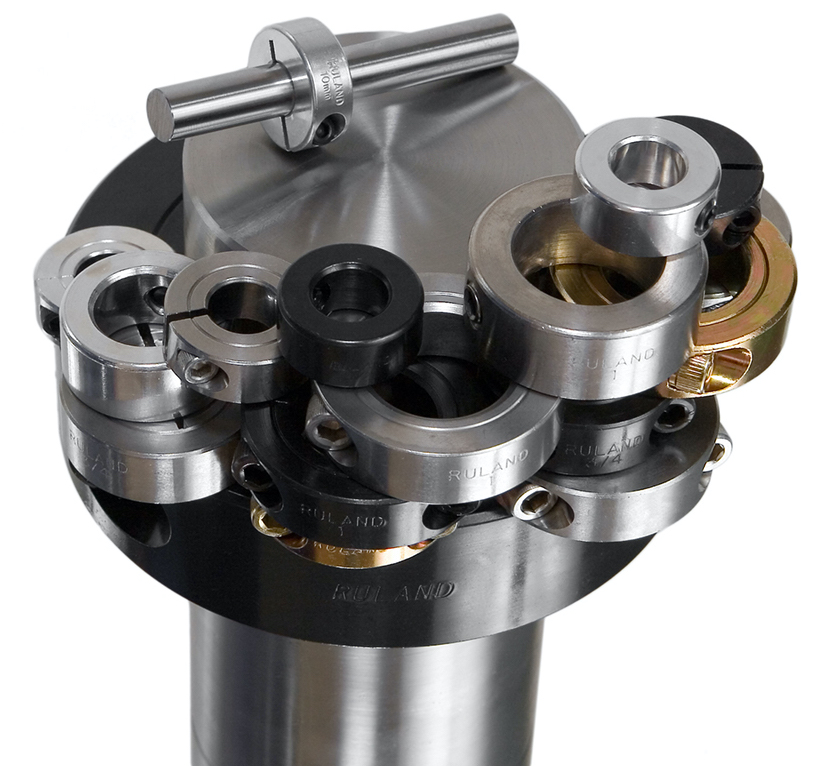
These are some examples of shaft collars from Ruland Manufacturing Co.
Couplings can drive the conveyor itself … or can go on conveyor accessories such as sorting switches. Of course, shaft collars and couplings are designed in on various manufacturers’ conveyors — and in many cases, the same exact part is used regardless of the system. This can make it challenging to identify what conveyor types are spiking in demand unless we are explicitly told by the manufacturer.
What applications have you supported over the last 12 months?
At Ruland, we’re expanding the types of couplings we offer to better meet the varied demands of our users. Over the last year, we’ve added Controlflex couplings and slit-type couplings to our lineup. We’ve also added universal joints and developed stainless-steel Oldham couplings.
Controlflex solves three specific encoder application requirements that our standard beam couplings do not.
1.First, Controlflex couplings have speed capabilities to 25,000 rpm in contrast with our standard beam couplings rated to 6,000 rpm. Of course, other beam couplings on the market are rated to 10,000 rpm … but these can be insufficient, as there are plenty of encoder applications that operate to 10,000 rpm and beyond.
2.Controlflex couplings can fit into confined spaces with a length-to-outer-diameter ratio under 1:1. Even in single-beam couplings — a standard style of encoder coupling — the ratio normally tops out at 1:1. Tight envelopes are common in encoders because mounts are often custom built … leading to a lack of standardization. Designers are usually trying to keep them on the shorter side to reduce the amount of misalignment. This can result in an unusual sizing relationship between the shaft sizes and coupling envelop requirements.
3.Lastly, Controlflex couplings come in myriad versions — including those with dramatically different bore-size combinations. At Ruland, our beam couplings usually have a large-to-small bore size ratio of 2:1. It’s not uncommon in an encoder to have a large motor shaft (such as 20 mm) connecting to a small encoder shaft — such as 8 mm, for example. Our standard beam couplings cannot accommodate this drastic step in shaft sizes. That’s because when we designed the beam coupling line, it was meant for encoders and light-duty servo applications … which meant we had to be able to maintain torque transmission throughout the bore range. Such large steps in shaft sizes made it challenging to rate the coupling to our desired torque level, because it would overcome the clamping force on an 8-mm shaft.
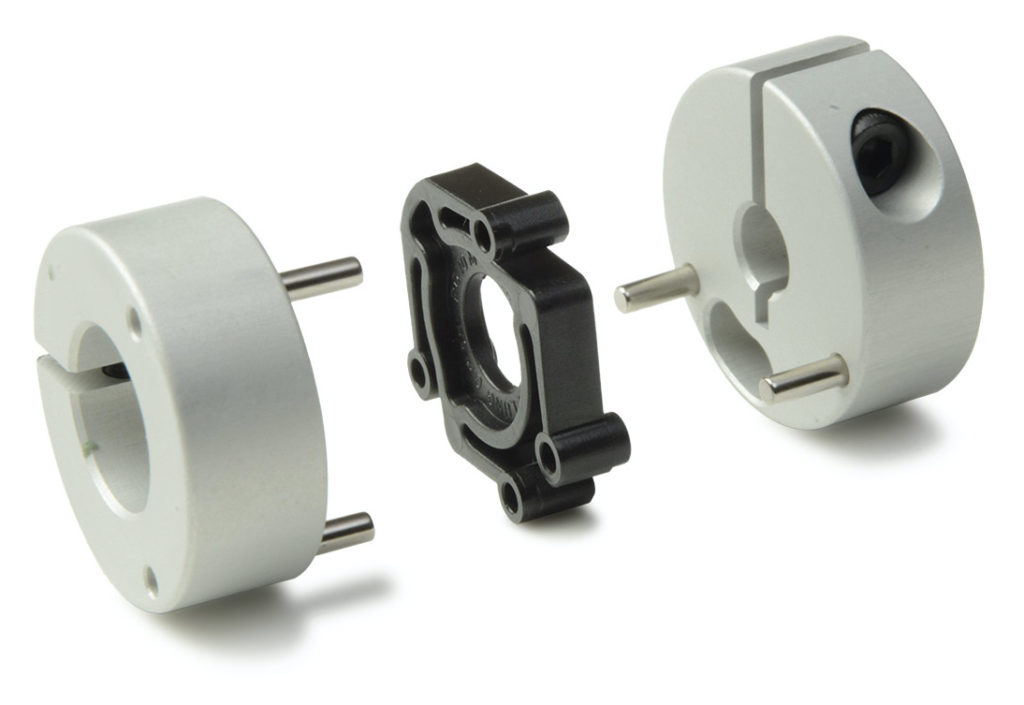
Controlflex couplings from Ruland Manufacturing Co. solve three encoder application requirements.
In contrast, Controlflex can handle a large-to-small bore ratio of up to 3.5:1 depending on the outer diameter size. This gives designers a lot of flexibility when selecting an encoder to attach to their motor.
Ruland is distributing Controlflex, which is manufactured by Schmidt Kupplung in Germany. We have had a long partnership with Schmidt, who owns our German distributor Orbit — so it made sense to partner on stocking and reboring Controlflex couplings.
What new support are you offering to laboratory automation or other industries that require small and precise builds?
缝隙耦合是我们最新的加法和填补four existing holes in our product range. They have small bore sizes down to 1.5 mm. These sizes are common in scientific and analytical equipment. Nothing in our standard product range fits sizes that small.
These new slit couplings also have speed capabilities to 70,000 rpm. Such speeds are common in those small shaft sizes … though even the larger bore sizes that cross into our standard size range have higher rpm options.
Thirdly, these new slit couplings have moderate torque and high misalignment capabilities. We don’t have another standard coupling that satisfies applications with parameters that fall between those that suggest the use of bellows or disc couplings and those that suggest the use of beam couplings with low inertia. After all, bellows and disc couplings are high-performance couplings that have limited misalignment capabilities. Aluminum beam couplings have limited torque and high misalignment capabilities … and stainless-steel beam couplings have high inertia. The high inertia is not desired in most motion control systems.
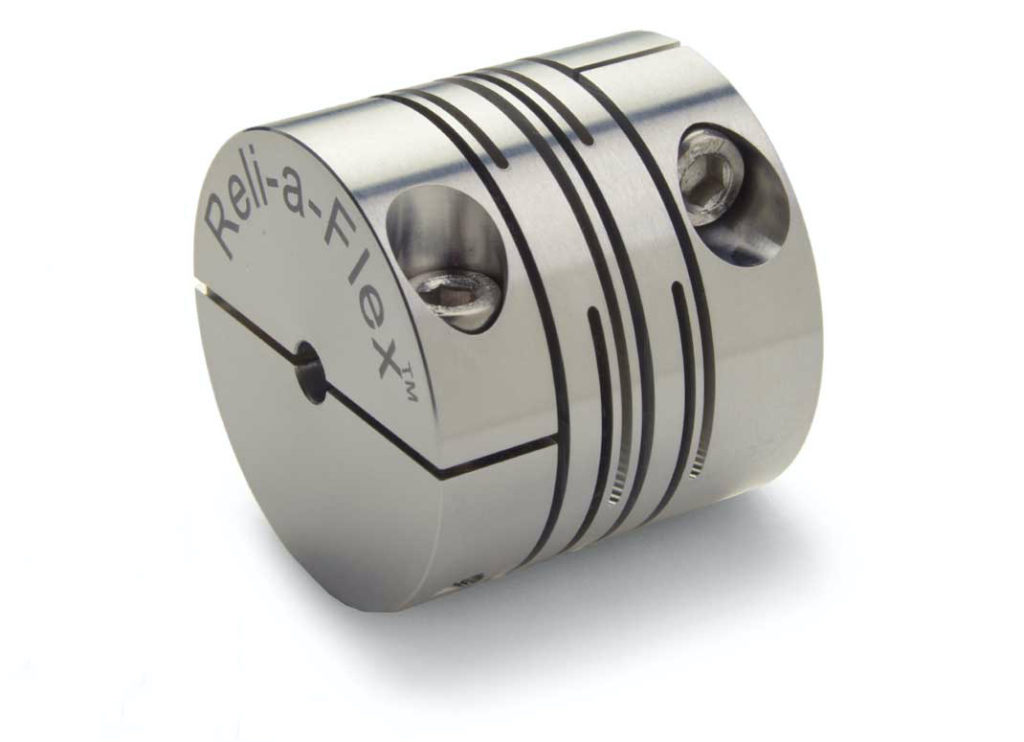
This is a double-slit Reliaflex flexible coupling from Ruland Manufacturing Co. to accommodate eccentricity and declination as well as axial misalignment between shafts. High-strength 7075-T6 Duralumin maintains twisting rigidity.
Slit couplings have torque capabilities comparable to those of stainless-steel beam couplings but with better overall misalignment capabilities.
Lastly, our newslit couplingscan fit in confined spaces and accommodate all misalignment forms. Currently, the only product we sell for high torque in tight envelopes is a single disc coupling. They have no accommodation for parallel misalignment which causes problems if misalignment can’t be precisely controlled.
我们的缝隙耦合是由公关的依赖ecision in Ireland. Reliance is well known for building precision assemblies and assisting companies with their designs. They have been using Ruland couplings as one of their standard options for many years.
Do any of your couplings go into food and beverage machinery subject to washdown?
Stainless-steel Oldham couplings were recently added to our standard offerings because they address three design challenges our other couplings do not.
1. Stainless-steel Oldham couplings aresuitable for food processing and packaging applications that may experience washdown. Our other coupling styles use aluminum as the base material. The exception is stainless-steel beam couplings … however, these are not a corrosion resistant coupling. The standard hardware is alloy steel and will rust which can lead to failure.
2. The stainless steel Oldham product line has a stainless steel screw giving itconsistent corrosion protection. Second, they can be used in high temperature applications. When combined with a PEEK disk they are capable of temperatures up to 148° C far surpassing anything else in our standard product range.
3. Lastly, stainless steel Oldham couplings excel in applications wherelow outgassingis required. Two caveats: This does require the use of a PEEK disk … and the end user may have to change out the standard screw (which has a proprietary anti-galling coating) depending on the application.
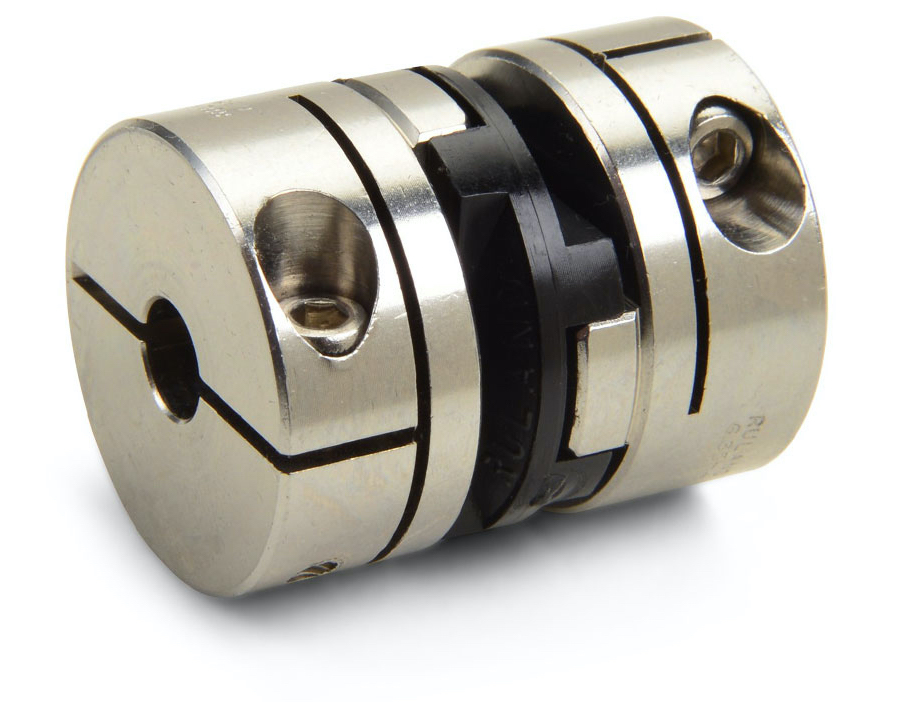
Shown here is a stainless-steel Oldham coupling from Ruland Manufacturing Co.
Describe how the increasingly common process of outsourcing the design of motion subassemblies has impacted you.
Ruland is seeing more coupling applications start with a design and prototyping firm as opposed to an OEM. This makes sense as companies have streamlined operations with R&D augmented by an outsourcing partner. As a manufacturer and component supplier, this trend hasn’t altered our process or interaction with customers. We may not know who the end customer is but the requirements won’t change and the mechanical engineers at the design firms have all the requisite expertise to properly select couplings … or give us the information to help in selection.
Where have your couplings been applied in robotic or AGV applications?
Ruland components are in numerous robotics applications. These systems often use smaller shafts and require zero-backlash operation — and that’s where our couplings fit in the market. Robotics covers a broad range of application requirements. Our vast coupling product line lets designers come to us as a single source and use standard off-the-shelf components regardless of system needs.
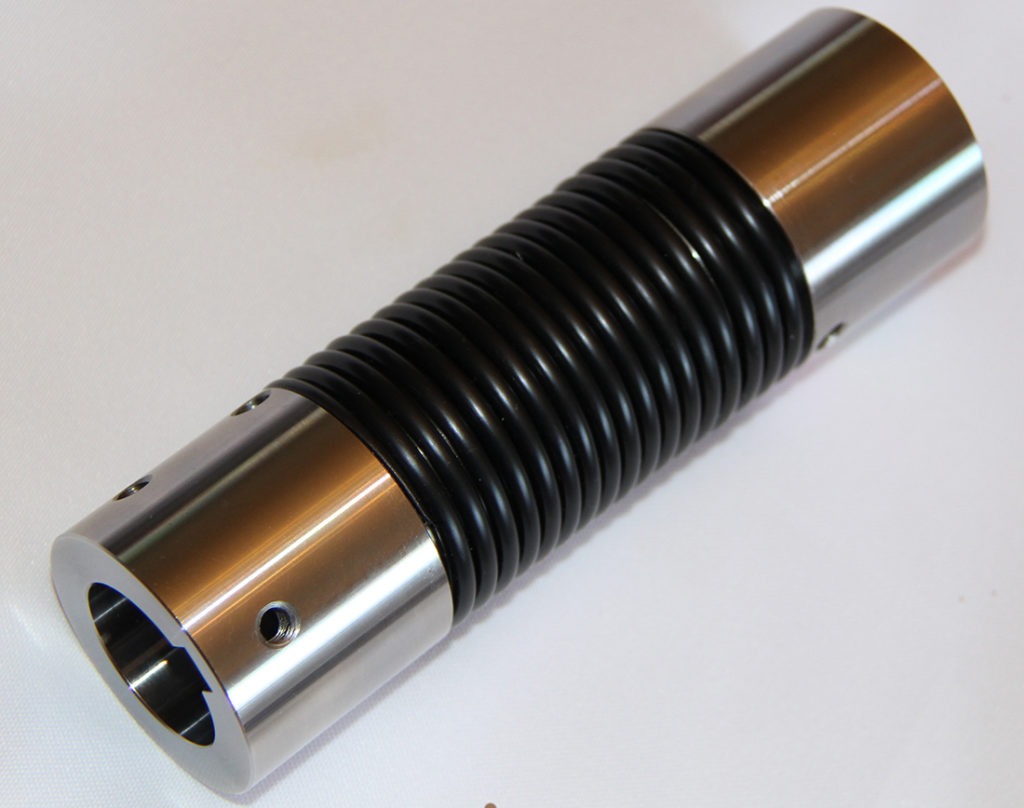
This is a new TSC150 coupling (to transmit up to 150 ft lb) from Twin Spring Coupling. The manufacturer is currently developing a smaller version called the TSC100 for compact industrial applications. In contrast with certain beam, bellows, and elastomeric couplings that can in some instances allow only limited misalignment angles. “Our couplings can be used at least twice that angle. This lets design engineers redesign equipment to leverage our couplings and their high flexibility — without having to resort to traditional options such as universal joints,” explains Twin Spring Coupling CEO and founder Darren Finch. “That in turn helps engineers avoid the maintenance issues some such technologies introduce — such as the requirement for constant lubrication, broken yokes, and worn bearings. “Our one-piece design and no internal bearings means we can offer the performance of the universal joint without the issues commonly associated with them,” adds Finch.
Filed Under:Coupling Tips


