

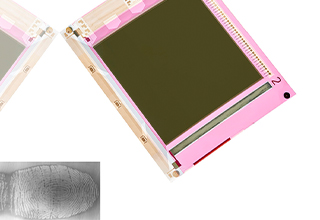
 Flexenable和Isorg揭示了世界上第一个专为生物识别应用而设计的塑料柔性指纹传感器。带8.6cm x 8.6厘米的有源区,84μm间距(78μm像素尺寸为6μm间距)和1024 x 1024 = 1048576像素分辨率,这一革命性的柔性传感器厚度仅0.3毫米,可在可见和近红外线上运行波长为900nm。该技术不仅能测量指纹,还能够单独提供手指中静脉的配置,而不是单独提供额外的安全性。
This new sensor breakthrough has been achieved by deposition of organic printed photodetectors (OPD), pioneered by ISORG, onto a plastic organic thin-film transistor (OTFT) backplane, developed by FlexEnable, to create a flexible fingerprint sensor that is ultra-thin, light, robust and lensless. The large label-thin sensing area can be applied to almost any surface – and even wrapped around the objects in our daily lives that we typically come into contact with – such as a car steering wheel that recognises the driver as soon as the wheel is touched, or a credit card with integrated biometric detection that does not compromise current form factors. The addition of vein sensing on top of fingerprint sensing provides a second level of security, since each user’s vein pattern in the finger is unique and requires the user to be alive for detection to be successful.
大面积指纹传感器允许收集更多信息 - 与较小的传感器区域相比,直接在两个关键指标上提供更好的性能 - 更高的安全性和较低的假拒绝率。然而,当使用传统的硅技术时,大面积指纹传感器对于许多应用来说对于许多应用来说都是昂贵的。相比之下,柔性塑料指纹传感器由于采用的塑料的低温和印刷过程而导致大面积制造的成本优势。此外,由塑料制成的指纹传感器对传统的光学指纹传感器具有类似的光学性能,例如灵敏度,线性度和低噪声,但不需要昂贵和庞大的光学器件。
FlexEnable
flexenable.com
ISORG
www.isorg.fr.
Filed Under:Sensor Tips


