Design World

  • Home
  • Technologies
    • 3D CAD
    • Electronics • electrical
    • Fastening & Joining
    • Factory automation
    • Linear Motion
    • Motion Control
    • Test & Measurement
    • Sensors
    • 流体动力
  • Learn
    • Ebooks / Tech Tips
    • Engineering Week
    • Future of Design Engineering
    • MC² Motion Control Classrooms
    • Podcasts
    • Videos
    • Webinars
  • LEAP AWARDS
  • 领导
    • 2022 Voting
    • 2021 Winners
  • Design Guide Library
  • Resources
    • 3D Cad Models
      • PARTsolutions
      • TraceParts
    • Digital Issues
      • Design World
      • EE World
    • Women in Engineering
  • Supplier Listings

FAQ: What are stepper drives and how do they work?

ByZak Khan|June 29, 2015

Share

A stepper drive is the driver circuit that controls how the stepper motor operates. Stepper drives work by sending current through various phases in pulses to the stepper motor. There are four types: wave drives (also called one-phase-on drives), two-phase on, one-two phase-on drives and microstepping drives.

Wave or one-phase-on drives work with only one phase turned on at a time. Consider the illustration below. When the drive energizes pole A (a south pole) shown in green, it attracts the north pole of the rotor. Then when the drive energizes B and switches A off, the rotor rotates 90° and this continues as the drive energizes each pole one at a time.
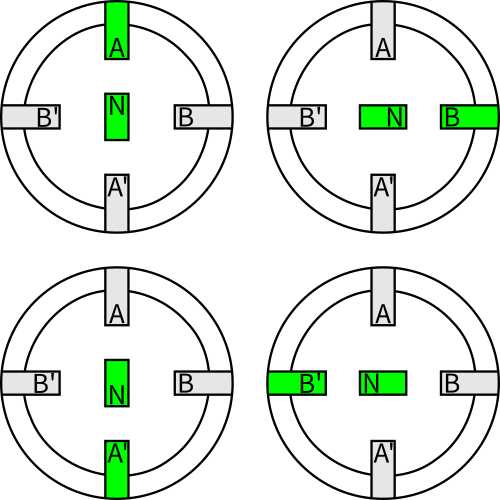
Stepper Drive One Phase On

Engineers rarely use wave driving: it is inefficient and provides little torque, because only one phase of the motor engages at a time.

Two-phase-on driving has its name because two phases are on at a time. If the drive energizes both A and B poles as south poles (shown in green), then the rotor’s north pole attracts to both equally and aligns in the middle of the two. As the energizing sequence continues on like this, the rotor continuously ends up aligning in-between two poles.
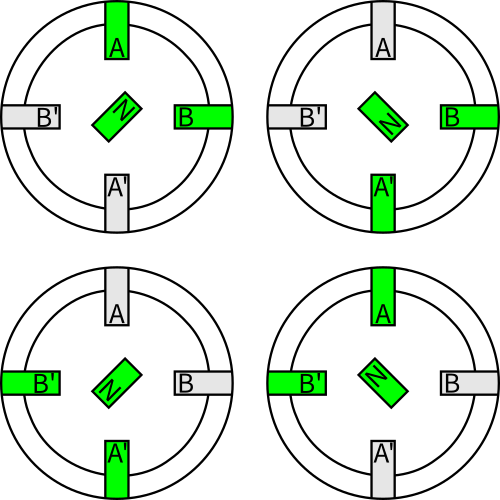
Stepper Drive Two Phase On

Two-phase-on driving gets no finer resolution than one-phase on, but it does produce more torque.

One-two phase-on driving has its name for the way the drive energizes either 1 or 2 phases at any specific time. In this driving method, also known as half-stepping, the drive energizes pole A (shown in green) … then energizes poles A and B … then energizes pole B … and so forth.
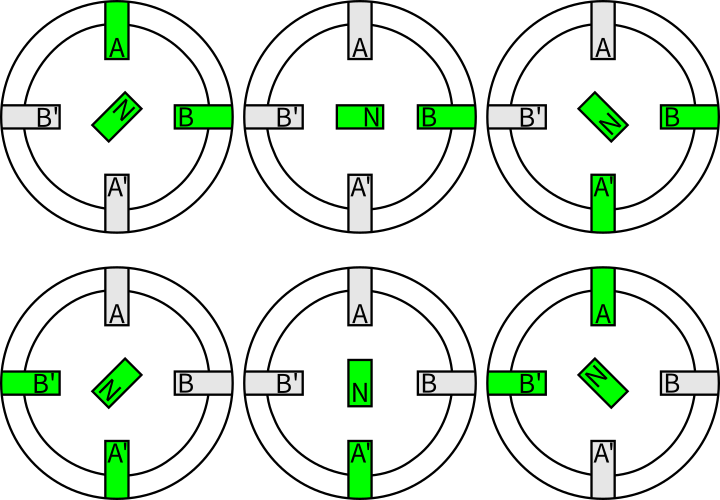
Stepper Drive One-Two Phase-On

One-two phase-on driving delivers finer motion resolutions. When two phases are on, the motor produces more torque. One caveat here: torque ripple is a concern because it may cause resonance and vibration.

Related to one-two phase-on driving is microstepping.

Microstepping delivers very fine motion resolutions. Here, the drive uses current regulation to prevent torque oscillations. With this technique, engineers can use stepper motors in more applications.

在排序,增加一个微步驱动nd decreases current along a sine wave, so no pole is fully on or off. Here is a sample microstepping sine-wave current:

Stepper Drive Microstepping Current Sine-Wave

Note the subtle jagged contour of the sine-wave current. While microstepping doesn’t necessarily improve accuracy, it does get higher resolution than other driving modes — which is particularly helpful for applications in which the motor goes through no-load situations. During operation, motors can miss steps. However, microstepping spreads energy out instead of delivering it to the motor all at once, which can cause ringing and overshoot.

For all of these forms of driving, the motors can have different windings. Unipolar motors only accept positive voltage. Unipolar requires an extra wire in the middle of every coil to let current flow from one end to the other. Bipolar stepper motors use both positive and negative voltage. Bipolar stepper motors have more torque because they produce a stronger magnetic field, but their construction also requires more wire.

For more information:

Oriental Motor’s website on stepper motors

University of Texas at Austin: Archived STMicroelectronics PDF

Online eBook: All About Circuits — Stepper Motors

Motion Control Tips


Filed Under:Motion Control Tips,Drives (stepper) + amplifiers


Related ArticlesRead More >

Conveyors support the shift to just-in-case manufacturing
What are digital twins and how are they used in industrial manufacturing?
Stepper motors feature on-board drive and control
Motion Plus now distributing MICRONIX USA products

DESIGN GUIDE LIBRARY

“motion

Enews Sign Up

Motion Control Classroom

Design World Digital Edition

cover

Browse the most current issueof Design World and back issues in an easy to use high quality format. Clip, share and download with the leading design engineering magazine today.

EDABoard the Forum for Electronics

Top global problem solving EE forum covering Microcontrollers, DSP, Networking, Analog and Digital Design, RF, Power Electronics, PCB Routing and much more

EDABoard: Forum for electronics

Sponsored Content

  • 10 Reasons to Specify Valve Manifolds
  • Case study: How a 3D-printed tool saved thousands of hours and dollars
  • WAGO’s smartDESIGNER Online Provides Seamless Progression for Projects
  • Stop over-designing: How to save time and money with a light-duty ring
  • Five Reasons: The 2065 Connector is a Reliable Alternative to Manual Soldering
  • Disaster recovery in industrial automation starts with source control

Design World Podcasts

February 27, 2022
What’s next for additive software
See More >
Engineering Exchange

The Engineering Exchange is a global educational networking community for engineers.

Connect, share, and learn today »

Design World
  • Advertising
  • About us
  • Contact
  • Manage your Design World Subscription
  • Subscribe
  • Design World Digital Network
  • Engineering White Papers
  • LEAP AWARDS

Copyright © 2022 WTWH Media LLC. All Rights Reserved. The material on this site may not be reproduced, distributed, transmitted, cached or otherwise used, except with the prior written permission of WTWH Media
Privacy Policy|Advertising|About Us

Search Design World

  • Home
  • Technologies
    • 3D CAD
    • Electronics • electrical
    • Fastening & Joining
    • Factory automation
    • Linear Motion
    • Motion Control
    • Test & Measurement
    • Sensors
    • 流体动力
  • Learn
    • Ebooks / Tech Tips
    • Engineering Week
    • Future of Design Engineering
    • MC² Motion Control Classrooms
    • Podcasts
    • Videos
    • Webinars
  • LEAP AWARDS
  • 领导
    • 2022 Voting
    • 2021 Winners
  • Design Guide Library
  • Resources
    • 3D Cad Models
      • PARTsolutions
      • TraceParts
    • Digital Issues
      • Design World
      • EE World
    • Women in Engineering
  • Supplier Listings
We use cookies to personalize content and ads, to provide social media features and to analyze our traffic. We also share information about your use of our site with our social media, advertising and analytics partners who may combine it with other information that you’ve provided to them or that they’ve collected from your use of their services. You consent to our cookies if you continue to use this website. OkNoRead more