Design World

  • Home
  • Technologies
    • 3D CAD
    • Electronics • electrical
    • Fastening & Joining
    • Factory automation
    • Linear Motion
    • Motion Control
    • Test & Measurement
    • Sensors
    • 流体动力
  • Learn
    • Ebooks / Tech Tips
    • Engineering Week
    • Future of Design Engineering
    • MC² Motion Control Classrooms
    • Podcasts
    • Videos
    • Webinars
  • LEAP AWARDS
  • 领导
    • 2022 Voting
    • 2021 Winners
  • Design Guide Library
  • Resources
    • 3D Cad Models
      • PARTsolutions
      • TraceParts
    • Digital Issues
      • Design World
      • EE World
    • Women in Engineering
  • Supplier Listings

FAQ: What is stepper drive idle-current reduction and why does it help?

ByZak Khan|August 15, 2016

Share

When stepper motors operate, they operate by drawing current continuously. This method of operation ensures more accurate positioning and more consistent torque. However, this also means an increase of energy they use and the amount of heat they produce. This holds true even when the stepper motor is idling.

Idling is not a very efficient operating mode for stepper motors or drives. This because the drive is supplying current, and the stepper motor is consuming it, but nothing is moving. Such unnecessary current draw wastes electricity and increases operating costs. Ideally, the motor would switch off whenever rotation is not occurring. However, this has its own set of drawbacks.

Recall that stepper motors usually must ramp up and down from its start and stop positions. If this is not done the stepper motor may skip or stall. As such, the motor cannot simply “switch off and on” it must accelerate and decelerate at the proper rates.

Idling current means the motor is still responsive. To reduce energy consumption yet still ensure positioning accuracy, the drive can supply far less current during idling than what it supplies regular operating conditions. That way the system can avoid some of the ramping up and down.
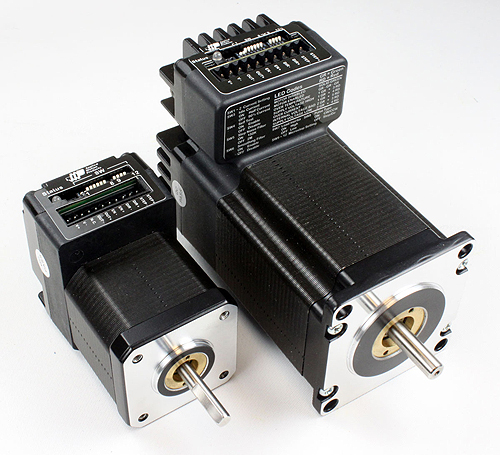
These are integrated drive and stepper motor units from Applied Motion that use idle-current reduction.

These are integrated drive and stepper motor units from Applied Motion that use idle-current reduction.

Idle-current reduction usually reduces the current sent from the drive anywhere from zero to 100 percent depending on how the drive’s configuration. Some drives can drop the supply of current automatically after a set period of no rotation. Manufacturers of drives that include idle current reduction list these values and thresholds in their motor’s documentation. Make sure that a drive’s current reduction technique and the amount of reduction is compatible with your system. Extended periods of no activity mean the motor is best switched off rather than changed to idling current while shorter periods of no activity are best for idling current.

For more information on idle-current reduction, read …

Applied Motion Products: 3540M – DC Microstep Drive

Motion Control Tips


Filed Under:Motion Control Tips,Drives (stepper) + amplifiers
Tagged With:appliedmotionproducts

Related ArticlesRead More >

Conveyors support the shift to just-in-case manufacturing
What are digital twins and how are they used in industrial manufacturing?
Stepper motors feature on-board drive and control
运动+现在分发MICRONIX美国产品

DESIGN GUIDE LIBRARY

“motion

Enews Sign Up

Motion Control Classroom

Design World Digital Edition

cover

Browse the most current issueof Design World and back issues in an easy to use high quality format. Clip, share and download with the leading design engineering magazine today.

EDABoard the Forum for Electronics

Top global problem solving EE forum covering Microcontrollers, DSP, Networking, Analog and Digital Design, RF, Power Electronics, PCB Routing and much more

EDABoard: Forum for electronics

Sponsored Content

  • Case study: How a 3D-printed tool saved thousands of hours and dollars
  • WAGO’s smartDESIGNER Online Provides Seamless Progression for Projects
  • Stop over-designing: How to save time and money with a light-duty ring
  • Five Reasons: The 2065 Connector is a Reliable Alternative to Manual Soldering
  • Disaster recovery in industrial automation starts with source control
  • HELUAKBEL – Your Source for IE Cable Solutions

Design World Podcasts

February 27, 2022
What’s next for additive software
See More >
Engineering Exchange

The Engineering Exchange is a global educational networking community for engineers.

Connect, share, and learn today »

Design World
  • Advertising
  • About us
  • Contact
  • Manage your Design World Subscription
  • Subscribe
  • Design World Digital Network
  • Engineering White Papers
  • LEAP AWARDS

Copyright © 2022 WTWH Media LLC. All Rights Reserved. The material on this site may not be reproduced, distributed, transmitted, cached or otherwise used, except with the prior written permission of WTWH Media
Privacy Policy|Advertising|About Us

Search Design World

  • Home
  • Technologies
    • 3D CAD
    • Electronics • electrical
    • Fastening & Joining
    • Factory automation
    • Linear Motion
    • Motion Control
    • Test & Measurement
    • Sensors
    • 流体动力
  • Learn
    • Ebooks / Tech Tips
    • Engineering Week
    • Future of Design Engineering
    • MC² Motion Control Classrooms
    • Podcasts
    • Videos
    • Webinars
  • LEAP AWARDS
  • 领导
    • 2022 Voting
    • 2021 Winners
  • Design Guide Library
  • Resources
    • 3D Cad Models
      • PARTsolutions
      • TraceParts
    • Digital Issues
      • Design World
      • EE World
    • Women in Engineering
  • Supplier Listings
We use cookies to personalize content and ads, to provide social media features and to analyze our traffic. We also share information about your use of our site with our social media, advertising and analytics partners who may combine it with other information that you’ve provided to them or that they’ve collected from your use of their services. You consent to our cookies if you continue to use this website. OkNoRead more