

More and more industries and manufacturers are requiring sensors for condition monitoring in their machines or processes. New digital signal conditioner technology is available that simplifies the use of eddy current (inductive) displacement sensors for high precision/high reliability applications. The technology is the best option for monitoring movement, position, vibration, alignment, or deflection, especially where parts operate in high temperatures or within environmental contaminants. Unlike previous versions that required circuit modifications and manual calibration to match the required target, sensor, cable length, and range, the new digital signal conditioners configure themselves in a matter of minutes. In addition, the technology works with a variety of sensors.
Many sensor options are available for machine condition monitoring, including inductive technology, linear variable differential transformers (LVDTs), laser triangulation, capacitive, and ultrasonic systems—as well as air gauging, Hall effect, and optical systems. Each technology has distinct advantages and disadvantages, depending on the application.
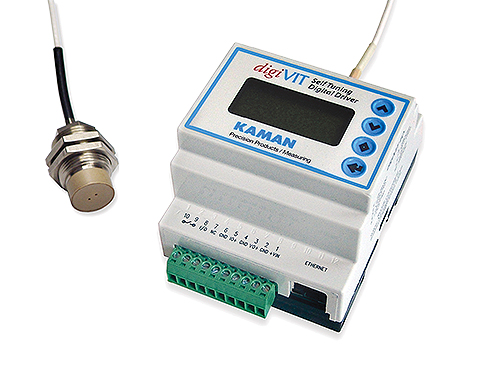
Eddy current sensors are generally more insensitive to environmental contaminants than other options. They operate on the principle of impedance variation caused by eddy currents induced in a conductive target by a sensor coil. The sensor coil is excited by a high frequency oscillator, which generates an electromagnetic field that couples with the target. Signal conditioning electronics sense impedance variation as the gap between sensor and target changes and translates it into a usable displacement signal. This technology provides extremely high (sub-micro inch) resolution.
Eddy current sensors can “see through” non-conductive materials, making these sensors useful in such applications as paint, rubber, and paper thickness. They can also be a good option for operation over a variety of temperatures and environments, including dust, oil, gas, diesel fuel, liquid oxygen, and rocket fuel.
Inductive technology is used for many high performance sensor applications, especially those needing higher frequency responses in challenging environments and temperatures. They allow operators to monitor a machine and determine when it has to be taken offline for maintenance. Conversely, the sensor may indicate that the machine is running well, so maintenance is not yet required. If, for example, the machine in question is a critical pump operating in an inaccessible location, precise information on machine condition can be important to a company’s bottom line.
High precision inductive sensors can also monitor or control the quality of a process. The sensors provide a real time control signal to the machine or a display to the operators so they can adjust machine performance.
以前的信号调整器技术要求哈rdware or software configuration to accommodate different sensors, target materials, cable lengths, and range. This was more costly, not to mention time consuming to set up. New digital signal processors, including digiVIT, simplify the use of eddy current sensors for high performance applications.
Calibration is performed by menu options and push buttons on the front panel, as opposed to adjustment of analog potentiometers. Reconfiguration, if required, can be performed in a matter of minutes. A highly linear output signal is achieved internally using digital linearization techniques. Temperature compensation of the output signal, desirable to minimize measurement temperature effects, is performed by the internal microprocessor and can be easily set up by the user, in many cases in-situ.
The digiVIT signal conditioner also includes user programmable functions, including:
• Relay set points for indication of out of tolerance conditions or process control
• Digital low pass filtering to improve resolution
• Adjustable sensor sample rate
• Quick 2-point adjustment instead of full calibration when replacing broken sensors
Some customer examples include:
Metal stamping process——这种金属冲压工艺,客户的铁ed stock must be checked for straightness and flatness. The metal type was changed several times a day. Eddy current technology was ideal for the oily machine environment, but required recalibration to each different type of metal, which was too time-consuming. With the digiVIT, recalibration took a matter of minutes, making the measurement practical.
Manufacturer with many large assembly machines— For this customer, monthly sensor calibration was required for quality control purposes. The sensors were located far from the signal conditioner making calibration of analog sensors difficult and time consuming. Replacing the analog systems with a digiVIT signal conditioner required only a 2-point calibration adjustment, reducing calibration time significantly.
Paper thickness measuring application combining the digiVIT with a laser—This customer performed a special calibration over a limited range to optimize resolution. Digital filtering and in-situ temperature compensation were enabled to further improve performance. The digiVIT proved very easy for the customer to implement.
Kaman Precision Products
www.kamansensors.com
Filed Under:Sensor Tips


