

By Orlando Perez, Orlando Perez is Senior Technical Product Manager for FARO Technologies
Two approaches
CAD introduced the capacity for design engineers to visualize in 3D, but it did nothing to help them interface with real-world products. For this, they had to await shape digitizers. Digitizers complete the feedback loop between a work-in-progress and CAD. Using these instruments, designers can make new iterations almost as quickly as revised shapes can be scanned or touched.
The earliest digitizers were contact instruments. A user would touch the object to be measured with the stylus on an articulating arm, press a button on the stylus’ handle, and record a point in space. Rotational transducers in the arm “joints” marked the position and orientation of the point, to an accuracy of 0.0002 in. By dragging the stylus along the object and depressing the button, a user can record a straight or curved line.
Images saved in the digitizer’s software are a collection of points or a wire frame, and are compatible with current surfacing software where they can be converted into 3D images suitable for CAD.Because they are portable and don’t require programming, contact digitizers created an instant niche for themselves, offering an alternative to large portage-type coordinate measuring machines (CMMs) that had been the standard of 3D measuring for over a decade. They continue to hold this niche and are favored for applications where 1000 or fewer points are necessary to describe an object.
The second basic type of digitizer employs lasers to capture surfaces. These can be further subdivided into those that capture relatively few points and those that create “point clouds.”
A hybrid type, known as a Laser Tracker, uses a spherical reflector to bounce a projected laser back to the emitter. Software in the instrument collects precision vertical and horizontal angles of the path of the beam, along with the distance to record the 3D position of the reflector, to an accuracy of 0.001 in.
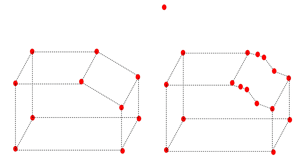
联系人数字数记录描述对象所需的点。点数取决于对象的形状。一个具有平坦侧面(左)的简单物体被拐角处的点捕获。具有曲线(右)的对象需要更多的点才能捕获它。
Like conventional contact digitizers, the Tracker is used more for point and line capture than point clouds. But Trackers are designed for capturing the image of large objects, at distances of up to 230 ft-far too great for contact digitizers. Design specs loaded into the instrument’s software become a checking tool to measure incremental changes as the hardware is built. For instance, the 50 ft Canadarm used by NASA to inspect the Space Shuttle in flight is built under the dimensional guidance of a Tracker.
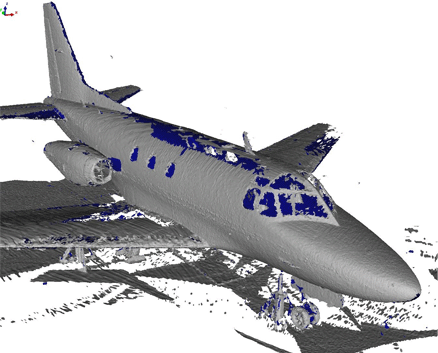
Trackers have largely replaced theodolites that were previously used for large-object dimensional measurement.They can be found checking specs on auto body assemblies, machine foundations, whole process-line setup (paper mills), and the curvature of yacht hulls.
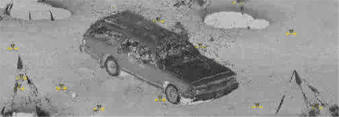
Forensic reconstruction of a bomb scene begins with the scene captured by scanner in which every pixel has X-Y-Z coordinates. Thus, the photo-like image can be zoomed, turned, measured, or viewed from any angle.
The latest digitizer generation creates 3D images with photographic realism. The images are typically two orders of magnitude more dense than those generated by contact digitizers or Trackers. Two types are available: Those for near imaging-ScanArms-and those for imaging larger or distant objects-Laser Scanners-such as whole airplanes, statues, tunnels, and architectural objects.
扫描仪用于特写和小对象成像,并使用与接触数字化器中发现的相同类型的发音臂构建。仅通过旋转仪器的头,扫描仪的杂种可以用作扫描仪或接触数字化的能力。在扫描模式下,头部被“飞向”靠近表面或部分。激光从表面弹跳,并记录在扫描头中。收集了极端细节。甚至捕获了诸如膝部和握力图案之类的表面纹理。通常,它们用于捕获从按钮到水桶的大小范围的图像,到±0.0030英寸的公差。
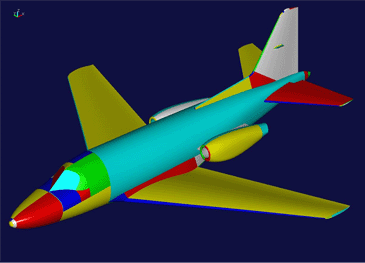
In software, raw data from digitizer (left) is converted through two steps into CAD image (above). Courtesy, Direct Dimensions.
If ScanArms are equivalent to the close-up 35-mm cameras of the metrology world, then Laser Scanners (LSs) are analogous to Ansel Adams’ view camera. These LSs are big- scene imagers, for covering everything from monuments to airplanes to crime scenes.
将图像工作
Dimensional verification: Perhaps the first application of digitizers was as parts and tooling checkers. Embedded CAD files of a part or tool became the go-gage in the instrument’s software. Technicians measure critical points on a part and the software compares them to the CAD standard, all the while building a running quality report. This data can be communicated between sister installations or between OEM and customers, almost instantly.
| Instrument | 物理范围 | Typical accuracy | Imaging rate | 软件compatibility | Applications |
| Articulating arm | 4 - 12英尺(1.2-3.65 m) | 0.0005 in. (0.013 mm) | NA | PolyWorks SolidWorks AutoCAD |
*铸件 * Windswept surfaces of 飞机 * Propellers (marine and aeronautical) |
| Laser tracker | 230 ft (70.1 m) |
0.001 in. (0.025 mm) |
350分/秒 | FARO CAM2 Measure FARO Insight Spatial Analyzer Metrologic Verisurf BuildIT 多沃斯 Geomagic Delcam |
* Process machines * Marine hulls * Part inspection * Tool building * Aerospace tooling and parts and assemblies * Automotive tooling, parts and assemblies *自动组装系统 |
| Scan Arm | 4 - 12英尺 (1.2-3.65 m) |
±0.030 in. (±0.762 mm) |
19,000 pts/sec | * Consumer products * Hand tools * Potted electronics |
|
| 激光扫描仪 | 249 ft (76 m) |
±0.118英寸 @ 82英尺 (±3mm @ 25m) |
120,000分/秒 | * Monuments *整个飞机 * Forensic scenes |
逆向工程:曾几何时,“反向gineering” was an uncomplimentary phrase that implied the copying of competitors’ products. Now, copying a physical object or model by taking a dimensional snapshot of it is an indispensable step in rapid prototyping. Digitizers capture changes in the shape of a model, in minutes instead of hours or days. Where two sides of an object are mirror images of each other, the designer has to copy only one side, then flip the image in software to create the other side.
Dimensional interaction: The old story about the fellow who built a boat in his basement — then discovered that it was too big to go out the door — happens at every level of engineering. How two objects move past each other is often critical to their function. Digitizers can recreate an existing 3D space, to almost any degree of detail necessary and in perfect proportion, with all surfaces measurable. Using this file, designers can model material flow, pipe layout, machine positioning, and clearances between interacting elements. Objects can be downloaded into these programs to check for clearance and interaction between them. One consulting group recreated the cockpit of an F-16 fighter so that the virtual cockpit could be used to position radios and other instrumentation ergonomically. In another case, a consultant recreated the entire containment room of a nuclear reactor so that a virtual “walk through” could be performed without endangering personnel.
流量分析:从NASCAR赛车手的空气流到金属模具的弹簧几乎每个流程过程,都可以通过计算流体动力学(CFD)而不是物理建模来评估,因为它更快,更便宜且更安全。通常,生产最终产品所需的设计迭代次数会降低数量级。该过程类似于逆向工程。
数字化器捕获了从挤出灭害到超音速飞机外表面的形状。然后,将表面应用到虚拟模型后,用户将FEA网格应用于表面并将其下载到评估流程模式的CFD程序中。在挤压死亡的情况下,设计迭代的数量从大约二十三到三下降,大大降低了加工“试验”死亡的成本;在飞机设计的情况下,飞机的飞机成本与风险一起消除。
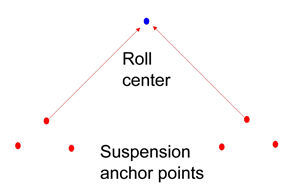
Technician measures suspension parts of NASCAR racer to locate roll center of the vehicle. The roll center is a point in space-difficult to measure with conventional instruments-that influences the vehicle’s handling characteristics. By measuring anchor points on the suspension, the technician is able to extrapolate lines to find the roll center.
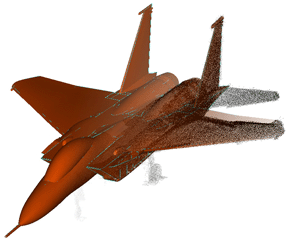
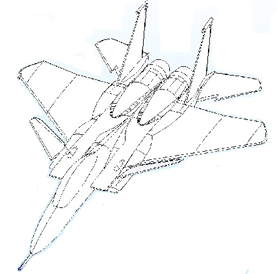
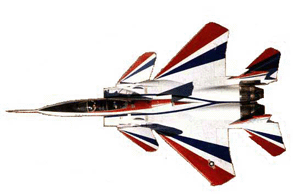
Scanners gather big images of big things, to an accuracy of 3 mm. Modified F-15 (left) was
scanned for CFD evaluation. After multiple angles were taken, files were linked and cleaned up in software to result in one large point cloud (center). Edges were defined (right) so that surfacing software could fill in the windswept surfaces. For CFD analysis, grid is applied so that changes in the front canard wing can be evaluated without the actual plane leaving the ground.
Filed Under:3D CAD,软件,Test + measurement • test equipment


告诉我们你的想法!