

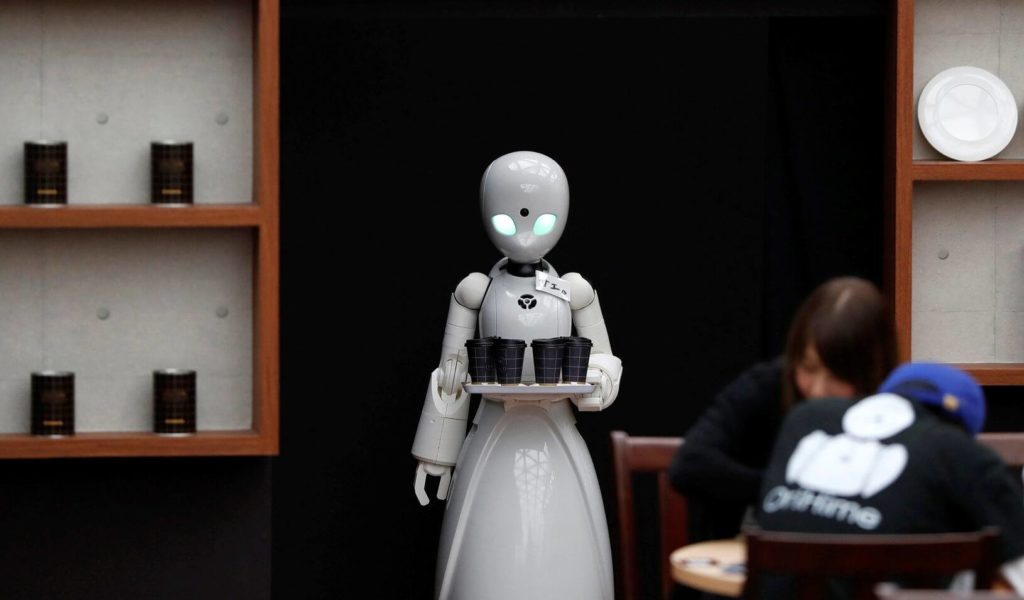
Artificial intelligence will shift jobs, not replace them. | Reuters/Issei Kato
Some good news: The robots aren’t coming for your job. Experts at the Conference on the Future of Work at Stanford University last month said that fears that rapid advances in artificial intelligence, machine learning, and automation will leave all of us unemployed are vastly overstated.
But concerns over growing inequality and the lack of opportunity for many in the labor force — serious matters linked to a variety of structural changes in the economy — are well-founded and need to be addressed, four scholars on artificial intelligence and the economy told an audience at Stanford Graduate School of Business (GSB).
That’s not to say that AI isn’t having a profound effect on many areas of the economy. It is, of course. But understanding the link between the two trends is difficult, and it’s easy to make misleading assumptions about the kinds of jobs that are in danger of becoming obsolete.
“Most jobs are more complex than [many people] realize,” said Hal Varian, Google’s chief economist, during the forum, which was sponsored by theStanford Institute for Human-Centered Artificial Intelligence.
Today’s workforce is sharply divided by levels of education, and those who have not gone beyond high school are affected the most by long-term changes in the economy, said David Autor, professor of economics at the Massachusetts Institute of Technology.
“It’s a great time to be young and educated. But there’s no clear land of opportunity” for adults who haven’t been to college, said Autor during his keynote presentation.
When predicting future labor market outcomes, it is important to consider both sides of the supply-and-demand equation, said Varian, founding dean of the School of Information at the University of California, Berkeley. Most popular discussion around technology focuses on factors that decrease demand for labor by replacing workers with machines.
However, demographic trends that point to a substantial decrease in thesupplyof labor are potentially larger in magnitude, he said. Demographic trends are also easier to predict, since we already know, aside from immigration and catastrophes, how many 40-year-olds will live in a country 30 years from now.
Comparing the most aggressive expert estimates about the impact of automation on labor supply with demographic trends that point to a workforce reduction, Varian said he found that the demographic effect on the labor market is 53% larger than theautomationeffect. Thus, real wages are more likely to increase than to decrease when both factors are considered.
Automation’s slow crawl
Why hasn’t automation had a more significant effect on the economy to date? The answer isn’t simple, but there’s one key factor: Jobs are made up of a myriad of tasks, many of which are not easily automated.
“Automation doesn’t generally eliminate jobs,” Varian said. “Automation generally eliminates dull, tedious, and repetitive tasks. If you remove all the tasks, you remove the job. But that’s rare.”
Consider the job of a gardener. Gardeners have to mow and water a lawn, prune rose bushes, rake leaves, eradicate pests, and perform a variety of other chores. Mowing and watering are easy tasks to automate, but other chores would cost too much to automate or would be beyond the capabilities of machines — so gardeners are still in demand.
Automation doesn’t generally eliminate jobs. Automation generally eliminates dull, tedious, and repetitive tasks. If you remove all the tasks, you remove the job. But that’s rare. –Hal Varian, chief economist, Google
Some jobs, including within the service industry, seem ripe for automation. However, a hotel in Nagasaki, Japan, was the subject of amused news reports when it wasforced to “fire”its incompetent robot receptionists and room attendants.
工作,与重复性的任务,往往不会disappear. In 1950, the U.S. Census Bureau listed 250 separate jobs. Since then, the only one to be completely eliminated is that of elevator operator, Varian observed. But some of the tasks carried out by elevator operators, such as greeting visitors and guiding them to the right office, have been distributed to receptionists and security guards.
Even the automotive industry, which accounts for roughly half of all robots used by industry, has found that automation has its limits.
“Excessive automation at Tesla was a mistake. To be precise, my mistake. Humans are underrated,” Elon Musk, the founder and chief executive of Tesla Motors, said last year.
 Keynotes|Speakers|Exhibitors|Register
The pace of jobs change
Technology has always changed rapidly, and that’s certainly the case today. However, there’s often a lag between the time a new machine or process is invented and when it reverberates in the workplace.
“The workplace isn’t evolving as fast as we thought it would,”Paul Oyer, a Stanford GSB professor of economics and senior fellow at theStanford Institute for Economic Policy Research, said during a panel discussion at the forum. “I thought the gig economy would take over, but it hasn’t. And I thought that by now people would find their ideal mates and jobs online, but that was wrong too.”
Consider the leap from steam power to electric power. When electricity first became available, some factories replaced single large steam engines on the factory floor with a single electric motor. That didn’t make a significant change to thenature of factory work, saysErik Brynjolfsson, director of the MIT Initiative on the Digital Economy. But when machinery throughout the factory was electrified, work changed radically.
The rise of the service sector
Employment in some sectors in which employees tend to have less education is still strong, particularly the service sector. As well-paid professionals settle in cities, they create a demand for services and new types of jobs. MIT’s Autor called these occupations “wealth work jobs,” which include employment for everything from baristas to horse exercisers.
The 10 most common occupations in the U.S. include such jobs as retail salespersons, office clerks, nurses, waiters, and other service-focused work. Notably, traditional occupations, such as factory and other blue-collar work, no longer make the list.
Looming over all of the changes to the labor force is the stark fact that birth rates in the U.S. are at an all-time low, said Varian. As has been widely reported, the aging of the baby boom generation creates demand for service jobs but leaves fewer workers actively contributing labor to the economy.
Even so, the U.S. workforce is in much better shape than other industrialized countries. The so-called dependency ratio — the proportion of people over 65 compared with every 100 people of working age — will be much higher in Japan, Spain, South Korea, Germany, and Italy by 2050. And not coincidentally, said Varian, countries with high dependency ratios are looking the hardest at automating jobs.
As the country ages, society will have to find new, more efficient ways totrain and expand the workforce, said the panelists. They will also have to better accommodate the growing number of women in the workforce, many of whom are still held back by family and household responsibilities.
The robots may not be taking over just yet, but advances in artificial intelligence and machine learning will eventually become more of a challenge to the workforce. Still, it’s heartening to be reminded that, for now, “humans are underrated.”
Editor’s note:This piecewas originally published by Stanford Graduate School of Business.
Filed Under:AI • machine learning,The Robot Report,机器人•机器人触手•结束了ctors


Tell Us What You Think!